If your SERP (Search Engine Results Page) reports look great but your organic traffic is flatlining, you aren't alone. In 2026, we have officially entered the "Answer-Based Search" era.
According to recent data, nearly 30% of search queries are now resolved entirely within the conversational interfaces of ChatGPT, Perplexity, and Gemini. For a people like us, this means a #1 ranking on Google is no longer the final victory—it's just the baseline.
This is every SEO over the past year: Haha!

At The Home Business Challenge, I believe in being a practitioner, not just a theorist. That’s why I disclose that I am an affiliate for several tools mentioned in my guides. When you use my links, you’re helping support my work in finding the best "Survival" strategies for home businesses. I’m an Amazon Associate and an affiliate for brands I trust. I’ll always give you my honest take, regardless of the commission, because your trust is my most valuable asset.
The Pivot from SEO to GEO
The biggest shift this year is the rise of Generative Engine Optimization (GEO). While traditional SEO focuses on "pulling" users to your website via blue links, GEO focuses on ensuring your brand is the cited source inside an AI's synthesized answer.
Enter: Semrush One
To combat this "zero-click" trend, SEMrush has consolidated its massive database into a new flagship platform: Semrush One. This isn't just a rebrand; it’s a structural shift that merges classic SEO tools with a dedicated AI Visibility Toolkit.
The AI Visibility Score: A new primary metric that tracks how often your brand is mentioned or cited across the major "Answer Engines."
The Citation Gap: Semrush now identifies "Narrative Drivers"—the specific topics where your competitors are being cited by AI as experts while you remain invisible.
Prompt Research: Think of this as the 2026 version of Keyword Research. Instead of just tracking "best social media tools," you are now tracking the volume and intent of conversational prompts like "Which social media tool is best for a scaling agency that wants to avoid a per-user tax?"
My Thoughts: In 2026, visibility is a two-front war. You are fighting for the human eye on Google and the machine's 'brain' in ChatGPT and Gemini. Semrush One is the first tool that acknowledges you can't win one without the other.
Inside the AI Visibility Toolkit (Decoding the Machine’s Mind)
In 2026, the question isn't just "Where do I rank?" but "How am I perceived?" The AI Visibility Toolkit is SEMrush's response to the black box of LLM decision-making. If you’ve ever wondered why ChatGPT recommends your competitor instead of you, this is where you find the answer.
The Three Pillars of AI Intelligence
Rather than a single list of keywords, this toolkit breaks your visibility down into three distinct, actionable reports:
1. Prompt Research: The New Keyword Magic Tool
Traditional keyword research tells you what people type into a search box. Prompt Research tells you what they ask a digital assistant. SEMrush’s 2026 database now includes over 213 million real-world LLM prompts.
Your Edge: You can now see "Estimated AI Search Volume"—the frequency with which specific questions are asked across ChatGPT and Perplexity.
Intent Mapping: The tool categorizes prompts into Research (informational), Shopping (commercial), and Comparison (transactional). If you are visible in research but missing in comparison, your middle-of-the-funnel content is broken.
2. The Mention-Source Divide
This is the most critical report for 2026. SEMrush differentiates between two types of visibility:
- AI Mentions: How often the AI names your brand (Great for awareness).
- AI Citations: How often the AI actually links to your site as the authoritative source (Crucial for traffic).
My Thoughts: If your mentions are high but citations are low, you are a "known entity" but not a "trusted source." The AI knows you exist, but it doesn't think your specific pages are worth sending a user to.
3. Narrative & Sentiment Analysis
By 2026, SEO has become a PR game. This tool scans LLM responses to see the sentiment associated with your brand.
Does the AI describe your software as "Enterprise-grade" or "Budget-friendly"?
Does it associate you with "Innovation" or "Legacy"? SEMrush plots this on a Sentiment Scatter Plot, allowing you to see if your brand narrative is actually sticking or if the AI is hallucinating a different identity for you.
The AI Search Health Audit
The Toolkit also adds a dedicated layer to the classic Site Audit. It flags technical issues that specifically block AI crawlers (like GPTBot or PerplexityBot).
Blocker Detection: It checks if your robots.txt is accidentally gating off your best data from the machine’s "training set."
Schema for Machines: It audits your structured data to ensure it’s optimized for Entity Recognition—making it easier for an AI to connect your brand name to your products.
The Classic Stack (Still the Gold Standard)
While the AI Visibility Toolkit is the shiny new toy of 2026, the core reason SEMrush remains a permanent fixture in an SEO's stack is its foundational database. Even in an AI-first world, you still need to win the traditional SERP to feed the machines.
Here is how the Classic tools have been upgraded for the 2026 landscape:
1. Keyword Magic Tool: The Semantic Scalpel
The 2026 update has pushed the database to over 28 Billion keywords. However, the magic isn't in the size; it's in the Personalized Difficulty (PKD%) and Intent Tagging.
Personalized KD%: Instead of a generic difficulty score, SEMrush now calculates how hard it will be for your specific domain to rank based on your existing authority and content clusters.
AI Intent Detection: Every keyword is now automatically tagged with one of four intents: Informational, Navigational, Commercial, or Transactional.
Pro Tip: I use the "Questions" filter combined with "Informational" intent to find perfect targets for Featured Snippets. If you win the snippet, you almost always win the AI citation as well.
2. Site Audit: Thematic Technical SEO
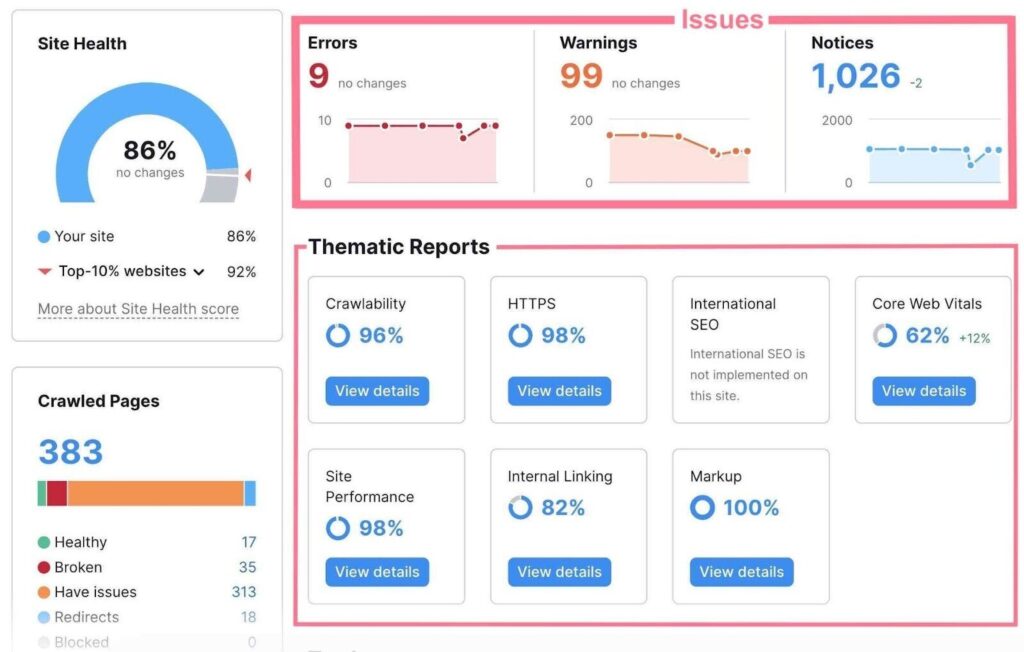
In 2026, technical SEO isn't just about fixing broken links; it's about speed, crawlability, and trust. The Site Audit has been reorganized into "Thematic Reports" that categorize issues by:
Crawlability & HTTPS: Ensuring Google and AI agents can actually reach your pages.
Core Web Vitals: Real-time monitoring of your site’s speed and stability metrics.
Entity & Schema: Auditing your structured data to ensure LLMs can identify your brand as an "Entity" with specific expertise.
3. Link Building CRM: Outreach at Scale
While Ahrefs is often praised for its link index, SEMrush wins on the workflow. Their Link Building Tool acts as a full CRM:
- Backlink Gap: Identifies sites that link to at least three of your competitors but not to you.
- Outreach Module: Connect your email (Gmail/Outlook) and send personalized, AI-assisted outreach directly from the dashboard.
- Monitoring: It automatically tracks if a gained link is ever deleted or changed to "nofollow," alerting you instantly so you can recover the lost authority.
Classic Stack Verdict: SEMrush vs. Ahrefs (2026)
| Feature | SEMrush | Ahrefs |
| Keyword Database | 28B+ (Leader in USA data) | 28.7B (Leader in Global/Intl) |
| Backlink Index | 43 Trillion (Raw Links) | 500M (Referring Domains - Fresher) |
| UX / Workflow | "Airplane Cockpit" (All-in-one) | "Well-Designed Car" (SEO Pure) |
| Technical Audit | Detailed Thematic Reports | Visually cleaner, less granular |
The classic stack is the engine room of your Digital Fortress. SEMrush remains the Swiss Army Knife because it doesn't just show you the data; it gives you the CRM and the Writing Assistant to actually do something about it.
Semrush Site Audit Checklist: Your First 2026 Site Audit
In 2026, a healthy site isn't just one without broken links. It’s one that is machine-readable. When you run your first audit in the new SEMrush interface, your goal is to move beyond the green "Site Health" score and dive into the AI Search Readiness data.
Use this checklist to ensure your site is fully optimized for both Google and the new Answer Engines.
Phase 1: The "Machine Readiness" Check (Critical for 2026)
- [ ] Review the AI Search Health Score: Locate the new widget in the Site Audit overview. Aim for a score of 90% or higher. This measures how well your site structure supports AI data extraction.
- [ ] Audit the "AI Blockers" Widget: Ensure your
robots.txtisn't accidentally blocking agents likeOAI-SearchBot(OpenAI) orPerplexityBot.
Pro Tip: In 2026, you should strategically allow AI agents to crawl your content for citations while blocking them from using your data for model training (using theGoogle-Extendedor specificNo-Trainingtokens). - [ ] Verify Schema for Entities: Check the Structured Data Thematic Report. Look for "Invalid" items. In 2026, search engines use this code to identify your brand as an Expert Entity. If your schema is broken, the AI cannot confidently cite you.
Phase 2: Performance & User Experience (The "INP" Era)
- [ ] Prioritize "Interaction to Next Paint" (INP): Look at the Core Web Vitals report. In 2026, Google has moved beyond simple load speeds. INP measures how fast your site reacts to a user's click. Your target should be under 200ms.
- [ ] Check for LCP Fetch Priority: Ensure your largest contentful paint (LCP) images are using the
fetchpriority="high"attribute. SEMrush will flag pages where the "Main Image" is being throttled by the browser. - [ ] AVIF Format Conversion: Audit your "Performance" report for heavy media. In 2026, AVIF is the required standard for high-performance sites, saving up to 50% more space than JPEG/WebP.
Phase 3: The Answer Engine Architecture
- [ ] Audit Heading Hierarchy (H1-H6): Use the Issues Tab to find pages with "Multiple H1s" or "Skipped Heading Levels." AI crawlers use headings as a roadmap; if your hierarchy is for styling rather than structure, the AI will fail to summarize your content correctly.
- [ ] The "BLUF" Audit: Manually check your top 10 high-impact pages. Do you use the "Bottom Line Up Front" method? The core answer to the user's query should be in the first 100 words to maximize your chances of a Featured Snippet or AI citation.
- [ ] Link Integrity & Orphaned Pages: Check the Internal Linking Report. Locate pages with "High Click Depth" (more than 3 clicks from home). If an AI crawler can't find a page easily, it will assume the content is low-priority and skip it.
This video provides a complete step-by-step tutorial on navigating the 2026 Semrush dashboard, specifically focusing on how beginners can set up their first project to bridge the gap between traditional SEO and AI search visibility.
Monthly Maintenance: The "Audit Drift"
Technical SEO isn't a 'one-and-done' event. In 2026, your CMS or team will inevitably introduce 'Audit Drift'—new plugins, unoptimized images, or broken redirects. Set your SEMrush Site Audit to Weekly Auto-Crawl and focus only on the 'New Errors' tab to keep your Fortress secure.
The 2026 "Scaling Tax" (Pricing Deep-Dive)
In 2026, SEMrush has shifted from a single subscription model to a Modular Ecosystem. While this allows you to customize your subscription, it also makes the checkout page look like a flight itinerary—full of potential "add-on" fees.
To help you scale without leaking margin, here is the objective breakdown of the two primary ways to buy SEMrush today.
1. The Semrush One Tiers (SEO + AI Bundles)
Introduced in late 2025, Semrush One is the new flagship. It combines classic SEO tools with the AI Visibility Toolkit at a discounted bundle rate. If you know you need to track your brand inside ChatGPT and Gemini, this is the most cost-effective path.
| Plan | Monthly Price | Annual (Monthly Avg) | Best For |
| Starter | $199 | $165 | Solo Specialists & Bootstrapped Brands |
| Pro+ | $299 | $248 | Growing Agencies (15 Projects) |
| Advanced | $549 | $455 | Enterprise Teams & High-Volume Agencies |
The Catch: These plans typically include only 1 user seat.
The AI Limit: The Starter plan includes 50 custom AI prompts. If you are tracking a massive catalog of products across AI engines, you’ll likely need the Pro+ tier for the 100-prompt limit.
2. The SEO Classic + Add-on Model
If you are a technical purist who doesn’t care about AI visibility yet, you can still stick to the SEO Classic plans.
Pro ($139/mo): 5 projects, 500 keywords.
Guru ($249/mo): 15 projects, 1,500 keywords + Historical Data.
Business ($499/mo): 40 projects, 5,000 keywords + API Access.
The Specialist’s Tax (Add-ons to Watch):
If you start with a Classic plan and realize you need the new 2026 features, here is what they will cost you "a la carte":
AI Visibility Toolkit: +$99/mo per domain.
Local SEO (Listing Management): +$30/mo.
Social Media Toolkit: +$20/mo (Though you already have ContentStudio for this!).
Additional User Seats: $45 to $100/mo depending on your base plan.
3. SEMrush vs. Ahrefs: The 2026 Value Gap
The biggest pricing shift this year is Ahrefs' new $29 "Starter" tier.
The Ahrefs Win: If you are a solo blogger who only needs to track 40 keywords and check backlinks, Ahrefs is now significantly cheaper than SEMrush’s $139 entry point.
The SEMrush Win: Once you move into the $250+ "Agency" range, SEMrush provides more "Value Per Dollar." SEMrush includes a full Content Marketing platform, a Link Building CRM, and daily rank updates—features that Ahrefs often gates behind higher tiers or credit-based usage.
My Thoughts on Pricing: In 2026, SEMrush is a 'Premium Tax' on your business. If you are an agency owner, the Semrush One Pro+ plan is the sweet spot—it includes 3 seats and the AI tools you need to prove ROI to clients. If you are a solo specialist just starting out, Ahrefs Starter or SE Ranking are better ways to protect your cash flow until you reach scale.
The GEO Bonus Workflow (How to Win the AI Citation War)
If you followed the checklist in the previous section, your site is technically "ready" for 2026. But "ready" doesn't mean "recommended." To get ChatGPT or Perplexity to actually cite you as the primary source, you need a proactive Generative Engine Optimization (GEO) workflow.
Here is the 3-step sequence I use inside SEMrush to move from invisible to authoritative in AI responses.
Step 1: Identify the "Citation Gaps"
Don't guess what topics AI care about. Use the Competitor Research report within the AI Visibility Toolkit.
The Action: Filter for prompts where your top 3 competitors are cited, but you are not.
The Insight: This reveals the "Trust Pattern." If the AI is citing a competitor's blog for "2026 Social Trends," it means that specific page has the structural markers the LLM is looking for.
Step 2: Optimize for Machine Readability (The BLUF Method)
LLMs don't read articles; they "retrieve" facts. To help them, we use the Bottom Line Up Front (BLUF) content structure.
The Action: Take the topics identified in Step 1 and run them through the SEMrush SEO Writing Assistant.
The Refinement: * Ensure every H2 is a direct question (e.g., "How much does SEMrush cost in 2026?").
- Ensure the first sentence under that H2 is a clear, definitive 20–30 word answer.
- Add a Table or Bulleted List immediately after. 2026 data shows that structured data formats are 40% more likely to be pulled into an AI summary.
Step 3: Seeding the Knowledge Graph (Off-Page GEO)
AI models don't just look at your site; they look at the consensus of the web.
The Action: Use the Brand Performance report to see which third-party sites are driving the narrative about your industry.
The Distribution: Target guest posts, podcast appearances, or even high-quality Reddit/Quora contributions on those specific Source Sites.
Pro Tip: In 2026, an unlinked brand mention on a high-authority site like Wikipedia or a major industry news outlet carries as much "GEO weight" as a backlink. It tells the AI: "This brand is a recognized entity in this space."
GEO isn't about gaming a system; it's about being the most helpful, easy-to-parse source on the internet. If you make the AI's job easy by providing clear facts in a structured format, the AI will reward you with the citation. It’s the ultimate win-win for 2026.
The Final Verdict (Is Your Fortress Future-Proof?)
In 2026, the question isn’t whether SEMrush is a "good tool"—it’s whether it’s the right investment for the specific stage of your business. After deconstructing the AI Visibility Toolkit, the technical audit upgrades, and the shifting pricing landscape, we can draw a definitive line in the sand.
The Scorecard
| Category | Rating | The Specialist's Take |
| Data Depth | 9.5/10 | Unmatched. 28B+ keywords and 43T backlinks mean you never fly blind. |
| AI Readiness | 9.0/10 | The industry leader in "GEO" tracking and LLM mention analysis. |
| Ease of Use | 6.5/10 | Significant learning curve. It’s an airplane cockpit, not a bicycle. |
| Value for Money | 7.5/10 | Premium pricing. It pays for itself only if you use at least 50% of the 55+ tools. |
Who Should Buy SEMrush One in 2026?
The Scaling Agency: If you manage 5+ clients, the unified reporting and Semrush One bundles are non-negotiable. The ability to show a client their "ChatGPT Share of Voice" is a 2026 power move that justifies your retainer.
The Full-Stack Marketer: If you handle SEO, PPC, and Content Strategy, having one "Intelligence Hub" saves you hours of tab-switching and data-reconciliation.
The Brand Defender: If your industry is being disrupted by AI answers (e.g., SaaS, Insurance, Reviews), you need the AI Visibility Toolkit to see who is stealing your narrative in the LLMs.
Who Should Skip It?
The Solo Niche Blogger: If you’re just starting your first site, the $165/mo "Starter Tax" will kill your margins. Stick with SE Ranking or Ahrefs Starter until you cross the $2,000/mo revenue mark.
The Technical Purist: If all you care about is "Link Juice" and you find the 55+ other tools to be "bloat," Ahrefs remains the cleaner, more surgically focused option.
Want to know more about Semrush?
[How to Scale Your Agency with Semrush: The Pro Command Center Guide]
[Stop Guessing, Start Growing: The Best SEO Reporting Software for 2026]
 No more wasting time learning – let’s start doing! My name is Becca and I’m your new digital BFF! 🙂 Let’s crush our side hustles together & turn them into full-time incomes!
0 Comments