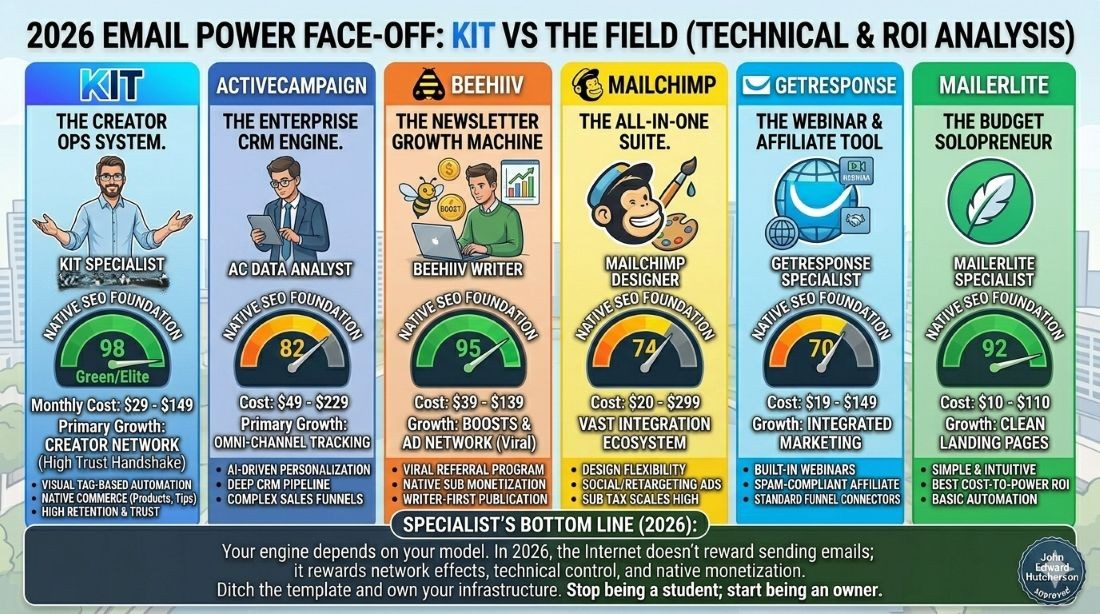
In late 2024, one of the most recognizable names in the industry—ConvertKit—did something bold. They didn’t just change their logo; they deleted half their name. They became Kit.
At first glance, it looked like a simple rebrand. But as a 10-year Technical SEO and Affiliate Specialist, I saw it for what it actually was: A declaration of war on Email Marketing... In a good way. 🙂
In 2026, the game has changed. We are no longer just sending broadcasts. We are building Digital Fortresses. The industry has split into two distinct camps:
- The Content Publishers: Who prioritize viral growth and ad revenue.
- The Systems Architects: Who prioritize high-ticket sales, deep CRM data, and owned infrastructure.
The "Subscription Tax" vs. The "Network Effect"
Most "gurus" tell you to pick the cheapest tool or the one with the prettiest templates. That is amateur advice. In this deep dive, we aren't looking at drag-and-drop builders. We are looking at the ROI of your infrastructure.
Does Kit’s new Creator Network actually deliver free subscribers, or is it just a high-priced handshake? Does ActiveCampaign’s AI-driven predictive sending justify its enterprise price tag? Or should you be looking at the efficiency of Beehiiv or MailerLite?
Bottom Line: Your business model dictates your infrastructure. If you choose the wrong engine, you’re just paying a "Subscriber Tax" on a car that can't finish the race.
Below, I’m breaking down the 6-Way Power Face-Off to help you decide if you need a "Kit" for your creator business, or if it’s time to upgrade to a full-scale CRM engine.
At The Home Business Challenge, I believe in being a practitioner, not just a theorist. That’s why I disclose that I am an affiliate for several tools mentioned in my guides. When you use my links, you’re helping support my work in finding the best "Survival" strategies for home businesses. I’m an Amazon Associate and an affiliate for brands I trust. I’ll always give you my honest take, regardless of the commission, because your trust is my most valuable asset.

Growth Mechanics — The Handshake vs. The Machine
If you are choosing between Kit and Beehiiv in 2026, you aren't just choosing an email editor. You are choosing a Growth Philosophy.
Both platforms have moved beyond "importing lists" and have built internal ecosystems to help you grow. However, the way they get you those subscribers is fundamentally different.
1. Kit’s Creator Network: The High-Trust Handshake
Kit’s primary growth engine is the Creator Network. It’s based on the "Recommendation" model.
How it works: When a new subscriber joins my list, a modal pops up suggesting 2–3 other creators I trust. If they join yours, you recommend me back.
Becca’s View: This is High-Intent Growth. Because a human being (a creator) is vouching for you, these subscribers arrive with pre-established trust. They are more likely to buy your products because they were referred by someone they already listen to.
The Math: Kit reports that creators using Recommendations see 2x faster list growth than those who don't.
The Catch: It requires manual networking. You have to find, vet, and "shake hands" with other creators in your niche.
2. Beehiiv’s Boosts: The Viral Scalability Machine
Beehiiv approaches growth like an ad platform. Their secret sauce is Boosts and their Native Referral Program.
How it works: Boosts: You can literally pay other newsletters to grow your list on a "Pay-per-Subscriber" basis. Unlike Facebook Ads, you only pay for verified, active subscribers.
Referral Program: Beehiiv has the best "Milestone" referral system (think: "Refer 5 friends, get a sticker; refer 10, get a shirt") baked directly into the platform.
Becca’s View: This is High-Velocity Growth. If you have a budget, you can turn on the faucet and gain 1,000 subscribers in a weekend. It’s perfect for media brands and newsletters where volume is the product.
The Catch: It’s transactional. These subscribers might not have the same "soul-level" connection to your brand as a peer recommendation from Kit.
The 2026 ROI Comparison
| Feature | Kit (Creator Network) | Beehiiv (Boosts / Referrals) |
| Growth Speed | Organic / Steady | Explosive / Paid |
| Subscriber Quality | Elite (Relationship-based) | High (Verified but Transactional) |
| Monetization | Selling Products & Courses | Selling Ads & Sponsorships |
| Cost of Growth | Free (Time-intensive networking) | Paid (Budget-intensive scaling) |
Becca's Verdict: If you are an entrepreneur building an authority brand where you want to sell a $497 course or high-ticket coaching, Kit’s high-trust handshake is the superior foundation.
If you are a Media Mogul building a news-style publication where you want to sell ad space to brands, Beehiiv’s viral machine will get you to 50,000 subscribers much faster.
The Automation Powerhouse — Kit vs. ActiveCampaign
If the last section was about how you get your audience, this section is about how you treat them once they arrive.
In 2026, there is a massive technical gap between a "Creator Automation" and a "CRM Pipeline." As an SEO, I see most entrepreneurs over-paying for complexity they never use. Let’s look at the "Ferrari vs. Commuter Car" dynamic.
1. Kit: The Elegant Creator Workflow
Kit is built on the philosophy of Tags, not Lists.
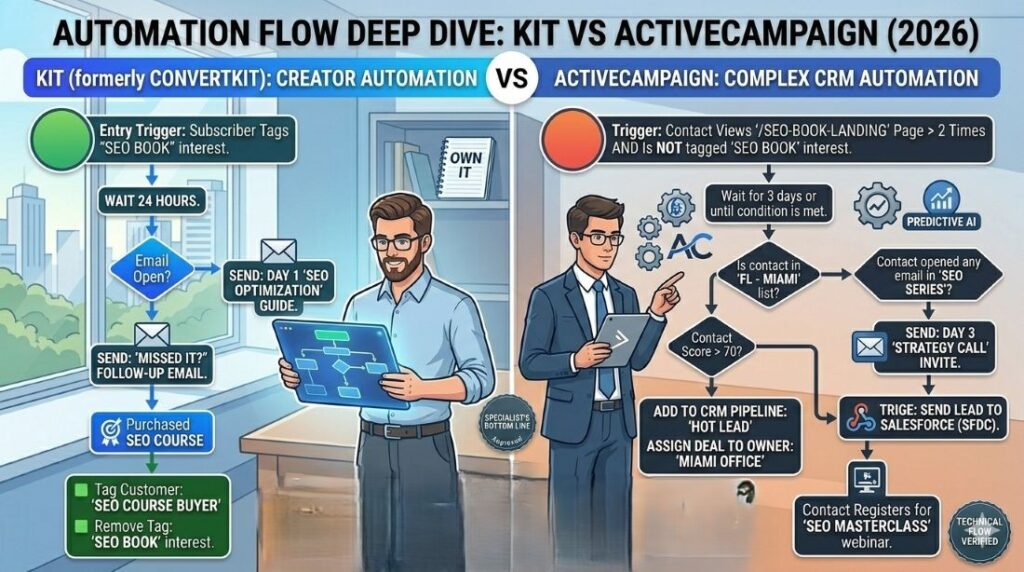
The Experience: It uses a clean, visual canvas. You can see your entire "Welcome Sequence" or "Product Launch" on one screen. It’s designed for a single person to manage without a dedicated "Marketing Operations" hire.
Becca’s View: Kit’s strength is Speed-to-Implementation. You can build a functional, high-converting automation in 15 minutes. It’s perfect for tagging people who clicked an interest link or segmenting Customers from Lookers.
Native Monetization: Kit wins here by allowing you to trigger automations based on Tip Jar donations or Paid Newsletter subscriptions directly within the app.
2. ActiveCampaign: The AI-Driven "Ferrari"
ActiveCampaign is a full-scale CRM (Customer Relationship Management) tool that happens to send email.
The Experience: It features a "Magic Star" AI icon throughout the builder. In 2026, its Predictive Sending tells you exactly when to email a specific lead based on their individual past behavior.
Becca’s View: This is Deep-Data Infrastructure. ActiveCampaign can track exactly which pages on your authority blog a user visited. If they view your "Coaching" page three times but don't buy, the system can automatically assign a "Task" to your sales rep or send a specific SMS follow-up.
ActiveCampaign also integrates very, very well with Shopify (which I have my own problems with). If you have a large and complex storefront in Shopify, ActiveCampaign might be worth considering.
The Trade-off: Complexity. As the flowchart below shows, ActiveCampaign’s power comes with a "Learning Tax." If you just want to send a weekly newsletter, ActiveCampaign is massive overkill.
Technical ROI Face-Off
| Feature | Kit (Creator Plan) | ActiveCampaign (Plus/Pro) |
| Automation Logic | Linear / Visual | Branching / Conditional |
| CRM Features | None (Tag-based only) | Elite (Deals, Pipelines, Tasks) |
| AI Capabilities | Basic (Subject lines) | Advanced (Predictive AI, Agentic flows) |
| Cost (10k Subs) | ~$139/mo | ~$189 - $239/mo |
Becca’s Verdict:
Choose Kit if you are a Solopreneur or Digital Product Seller. You need to spend your time creating content, not debugging 50-step automation branches. Kit gives you 90% of the power with 10% of the headache.
Choose ActiveCampaign if you have a Sales Team or a Complex E-commerce Store. If your business depends on "Lead Scoring" and knowing exactly when a high-ticket prospect is "warm," the extra $100/month for ActiveCampaign’s CRM is the best investment you’ll ever make.
One Final Warning: Don't buy the Ferrari (ActiveCampaign) if you're only driving to the grocery store. Most "ActiveCampaign users" I audit are only using 15% of the features but paying 100% of the price.
The "Old Guard" Face-Off — Kit vs. Mailchimp & GetResponse
If Kit is the "New School" of creator systems, Mailchimp and GetResponse are the industry’s "Old Guard." They have been around since the beginning, but in 2026, they’ve evolved into two very different beasts.
One has become an Omnichannel AI Giant, while the other has doubled down as the Ultimate Funnel & Affiliate Tool. Here’s how they stack up against Kit’s specialist focus.
1. Mailchimp: The All-in-One AI Powerhouse
Mailchimp (owned by Intuit) is no longer just an email tool; it’s a full-scale marketing platform that integrates deeply with QuickBooks and Shopify.
The 2026 Edge: Predictive AI. Mailchimp’s new "Site Tracking Pixel" and AI-powered insights can tell you which customers are "at-risk" of leaving or which are "high-value" buyers likely to purchase next.
Becca’s Warning: The "Subscriber Tax." Mailchimp is notorious for charging you for every contact—including people who have unsubscribed or never confirmed their email. As your list grows, this "tax" can become a massive drain on your ROI.
Verdict: Choose Mailchimp if you run a physical e-commerce store and need a tool that handles email, SMS, and retargeting ads in one place.
2. GetResponse: The Affiliate-Friendly Funnel King
While many platforms (including Mailchimp) can be "twitchy" about affiliate marketing, GetResponse has always welcomed it with open arms.
The 2026 Edge: Native Webinars & Funnels. This is GetResponse’s "killer app." You can host a live webinar for up to 1,000 people, build the registration page, and process payments without ever leaving the platform.
Becca’s View: At 10,000 subscribers, GetResponse often costs half the price of Kit ($59 vs. $119) while offering more features like automated "Price Drop" campaigns and abandoned cart recovery.
Verdict: Choose GetResponse if you are an Affiliate Marketer or Course Creator who relies on webinars and pre-built "Conversion Funnels" to close sales.
2026 "Old Guard" Metrics (at 10,000 Subs)
| Metric | Kit | Mailchimp (Standard) | GetResponse (Auto) |
| Monthly Cost | $119 - $149 | ~$135 | ~$59 - $79 |
| Best Asset | Creator Network | AI Predictive Data | Webinar Funnels |
| Affiliate Friendly? | Yes | Strict (Proceed with Caution) | Elite (Industry Favorite) |
| Technical Feel | Specialist / Minimal | Corporate / Feature-Rich | All-in-One / Functional |
Becca’s Verdict
Ditch Mailchimp if you are a scrappy affiliate. You’ll pay too much for "inactive" contacts and risk getting your account flagged for affiliate links.
Choose GetResponse if you want the absolute best Feature-per-Dollar ratio. If you need a webinar room and a funnel builder, GetResponse saves you an extra $100/month in third-party software costs.
Stick with Kit if you value the Network. GetResponse has the tools, but Kit has the people. If you want other big creators to recommend you, Kit is the only place that happens natively.
Another quick note: I used GetResponse quite a bit in the past. In fact, I like it. The biggest downside is that it costs right out of the gate. Kit is amazingly generous by allowing up to 10,000 subscribers for free.
So it really does come down to where you are in your business. If you already have or know you will quickly have subscribers coming in and automations that you want to set up, GetResponse will be more cost effective. However, if you're just starting out, still learning the ropes, and not sure when you'll start getting leads or set up an automation, Kit is a great place to start because it allows you to get set up for free with no time restraints.
When I was starting out, I hated spending money on email marketing platforms each month because I knew I needed to get everything set up, but I wasn't quite ready to bring in subscribers or even know how to at that point.
When Kit added a free plan, it became quite a no-brainer to move to them until I was ready to level up.
The Value Play — Kit vs. MailerLite
If you are a specialist who values ROI above all else, This is for you. In 2026, the gap between "Premium" and "Budget" has narrowed technically, but the price difference remains staggering.
MailerLite is essentially the "HBA" of email marketing—it’s clean, it’s fast, and it gives you 90% of the power for 50% of the cost. But as a specialist, you need to know exactly what you’re giving up to save that money.
1. MailerLite: The King of the "Efficiency Floor"
MailerLite has built its 2026 reputation on being the most intuitive drag-and-drop builder on the market. While Kit focuses on "plain text for deliverability," MailerLite gives you the creative freedom to build beautiful, modern newsletters without needing a design degree.
The 2026 Edge: AI-Powered "Smart Sending." MailerLite’s 2026 update includes an AI teammate that analyzes your specific audience's habits. It doesn't just send at a "best time"—it optimizes the send time for each individual subscriber based on when they historically click.
The "Clean List" Advantage: Unlike almost every other provider, MailerLite makes it incredibly easy to find and remove inactive subscribers. They don't want you overpaying for "dead weight," which keeps your deliverability high and your bill low.
2. The Pricing Gap (The "Specialist's Math")
This is where the rubber meets the road. Let’s look at what it costs to manage a list of 10,000 subscribers in 2026:
Kit (Creator Plan): ~$139 / month
MailerLite (Growing Business): ~$73 / month
Becca’s Take: You are paying a $66/month "Creator Premium" for Kit. Is it worth it? It's hard for me to say. I do love Kit, but this is pretty appealing. It's been a few years since I tested MailerLite, but it may be time to hop back in and see the changes and upgrades they made.
3. What You Lose When You Choose "Budget"
Saving $800 a year sounds great, but as a specialist building a Digital Fortress, you need to consider these three "Kit-only" assets:
- The Creator Network: MailerLite has zero native "Recommendation" engine. You are responsible for 100% of your own traffic and growth.
- Monetization Friction: Kit allows you to sell digital products and paid newsletters natively. With MailerLite, you’ll likely need a third-party tool (like Gumroad or Stripe) which adds back the complexity you were trying to avoid.
- Tagging Granularity: While MailerLite has automations, Kit’s Subscriber Graph is technically superior for hyper-segmenting people based on precise behaviors (e.g., "Clicked the SEO link 3 times but never opened the Facebook Ads email").
Becca's Verdict:
- Choose MailerLite if you are a Budget-Conscious Solopreneur or a small business owner. If you already have a steady traffic source (like a high-ranking SEO blog) and don't need a "Network" to grow, MailerLite provides the best technical value in the industry.
- Choose Kit if you are a Pure Creator. If you want to grow by networking with other creators and want "one-click" monetization of your list, the $66/month premium is actually a bargain.
The 2026 Comparison Matrix — The Cheat Sheet
To wrap up the technical battle, we need to look at the cold, hard numbers. In 2026, the "Subscriber Tax" is real. As your list grows, the cost of your infrastructure can either be a rounding error or your biggest monthly expense.
Here is the definitive breakdown of the "Big Six" based on a 10,000-subscriber benchmark.
2026 Email Power Matrix (10k Subscribers)
| Platform | Monthly Cost (Est.) | Primary Growth Engine | Affiliate Payout | Specialist Verdict |
| Kit | $119 - $149 | Creator Network (Handshake) | 50% (1st yr) / 10-20% (Life) | The Creator's Choice |
| ActiveCampaign | $189 - $239 | Omni-Channel Tracking | 20% - 30% (Recurring) | The CRM Powerhouse |
| Beehiiv | $99 - $109 | Boosts & Ad Network | Up to 60% (1 yr) | The Media Mogul |
| Mailchimp | $135+ | AI Insights / Ads | $40 CPA / 25% (Agency) | The E-commerce All-in-One |
| GetResponse | $59 - $79 | Webinar Funnels | 33% (Life) or $100 CPA | The Funnel Specialist |
| MailerLite | $73 | Clean UI / Smart AI | 30% (Life) | The Budget Hero |
Strategic Breakdown: Why the "Affiliate Payout" Matters to YOU
You shouldn't just look at what a tool costs you—you should look at how it can pay you.
- The "2-and-Free" Math: If you use Kit, its aggressive 50% commission for the first year means that if you refer just two peers to the platform, your own software cost is effectively $0. This is the ultimate move for 2026.
- The High-Ticket Play: If you are an agency or a consultant, ActiveCampaign's 30% recurring commission on a $200/month plan is a significant "Residual Floor" for your business.
- The Scaling Trap: Mailchimp remains the hardest to monetize as an affiliate. Their move toward a CPA (one-time payment) or agency-only model makes it a "cost center" rather than a "revenue center" for most creators.
The Bottom Line: In 2026, deliverability is a commodity. Every platform on this list will get your email into the inbox. The decision comes down to Network Effects and Affiliate ROI.
- If you want to grow through Relationships, go with Kit.
- If you want to grow through Data, go with ActiveCampaign.
- If you want to grow through Viral Loops, go with Beehiiv.
Bonus Tip: The 2026 "Zero-Loss" Migration Strategy
The biggest fear for any specialist is migrating a list only to see open rates plummet from 40% to 4%. In 2026, inbox providers like Gmail and Outlook are more aggressive than ever. If you simply "import and blast," you will be flagged as a spammer before your first coffee break.
Here is the technical checklist to move your list while keeping your deliverability "Elite."
1. The Clean-First Rule
Never migrate your entire list. Export your data from your old provider, but run it through a tool like NeverBounce or Clearout before importing it into Kit or ActiveCampaign.
The Goal: Remove "hard bounces" and "spam traps" that have accumulated over the years. Starting a new platform with a 0% bounce rate sends a massive Trust Signal to ISPs.
2. Authenticate Before You Send
In 2026, DMARC, SPF, and DKIM are non-negotiable.
Most platforms like Kit provide a "Migration Concierge" that helps you set these up.
Pro Tip: Look into BIMI (Brand Indicators for Message Identification). It allows your logo to show up next to your email in the inbox, which can boost open rates by up to 10% simply through brand recognition.
3. The "Engaged-Only" Warm-up
Don't send to your whole list on Day 1.
Step 1: Create a segment of your "Super-Fans" (those who have opened or clicked in the last 30 days).
Step 2: Send your first three emails only to this group.
The Logic: This generates a high open-to-send ratio (80%+). Inbox providers see this engagement and "whitelist" your new sending IP, making it safe to gradually introduce the rest of your list.
4. The "Final Forward" Trick
Keep your old account active for at least 30 days after the switch. Set up a "Catch-all" forwarder. You'd be surprised how many high-value leads might reply to an old automated thread; you don't want those gold nuggets falling into a digital black hole.
Need a "Done-For-You" Move?
If you have more than 5,000 subscribers, many of the big email marketing platforms offer a Concierge Migration Service:
- Offers free "White Glove" migration for any paid plan. They’ll move your forms, sequences, and subscribers for you.
- Provides free expert migration to map over your complex CRM pipelines.
- Features a 1-click import tool specifically optimized for moving.
The Bottom Line on Migration: In 2026, a migration is a re-introduction, not just a data transfer. Treat your first 30 days on a new platform like a first date: be on your best technical behavior.
The Scaling Tax — The 25k vs. 50k Reality Check
In the early days (0–10k subscribers), a $20 difference in your monthly bill feels like a couple of lattes. But once you cross the 25,000 subscriber mark, the pricing models of these "Titans" begin to diverge aggressively.
In 2026, this is where most creators hit a "Growth Wall"—not because their content is failing, but because their infrastructure costs are eating their profit margins. Let’s look at the math.
The 2026 "Scaling Tax" Comparison
All prices reflect the "Pro" or "Advanced" equivalent tiers to ensure we are comparing similar automation features.
| Platform | 10k Subs | 25k Subs | 50k Subs | Scaling Tax (10k → 50k) |
| $139 | $199 | $379 | +172% | |
| ActiveCampaign (Plus) | $239 | $489 | $759 | +217% |
| Beehiiv (Scale) | $109 | $149 | $199 | +82% |
| Mailchimp (Standard) | $135 | $270 | $450 | +233% |
| GetResponse (Marketer) | $88 | $168 | $285 | +223% |
| MailerLite (Growing) | $73 | $160 | $289 | +295% |
Three Critical Takeaways for the Scaling Specialist
1. The Beehiiv "Flat" Advantage
Notice the Beehiiv line. Between 25k and 50k subscribers, their price only moves by $30. Because Beehiiv is built for publishers (who often have lists in the hundreds of thousands), their pricing scales much more gracefully. If you are a high-volume newsletter, the "Tax" on Beehiiv is almost non-existent compared to the field.
2. The ActiveCampaign "Luxury Tax"
ActiveCampaign is the most expensive platform at every tier. By 50,000 subscribers, you are paying $759/month. At this level, you aren't just paying for email; you are paying for a data warehouse. If you aren't using their Lead Scoring and CRM pipelines to close high-ticket sales, you are essentially setting $500/month on fire.
3. The Mailchimp "Shadow Tax"
While Mailchimp’s $450/month looks comparable to Kit, remember: Mailchimp counts unsubscribed and non-subscribed contacts in your billing. If you have 50k active subs but another 15k who have unsubscribed over the years, Mailchimp will bill you for 65,000 contacts, potentially pushing your bill over $600. Kit and MailerLite only charge for active subscribers.
The Verdict on Scaling:
If you want to stay "Lean": Beehiiv is the undisputed king of scaling. You can have 50,000 subscribers for less than what ActiveCampaign charges for 10,000.
If you want "Power": Kit sits in the "Goldilocks Zone." It's more expensive than Beehiiv but significantly more affordable than the enterprise CRM tools. It's the right balance for a creator selling a $2,000 course.
If you are "Budget-Only": MailerLite starts the cheapest, but its price jumps are the steepest percentage-wise. It’s a great "starter engine," but by 50k subs, you might find more value in moving to a specialist platform like Kit.
The Final Verdict: Which Digital Fortress Are You Building?
In 2026, there is no such thing as a "best" email platform—there is only the best platform for your specific Business Model. After 10 years of technical SEO and affiliate audits, here is my definitive breakdown to help you stop "renting" your audience and start "owning" your infrastructure.
1. The Creator Architect
If your business revolves around YOU—your courses, your coaching, and your personal brand—Kit is the undisputed heavyweight champion.
Why: You aren't just buying an email tool; you're buying into the Creator Network. It is the only platform where the "Growth Tax" is offset by a "Growth Engine" of other creators recommending you for free.
Verdict: Choose Kit if you want High-Trust Growth and the simplest path from "Subscriber" to "Customer."
2. The Data Scientist
If you are running a high-ticket agency, a complex B2B service, or an e-commerce store with 100+ SKUs, you need a Ferrari.
Why: You need CRM Pipelines. You need to know that "Lead A" visited your pricing page three times but hasn't booked a call yet. ActiveCampaign’s Predictive AI is worth the enterprise price tag only if you are using it to trigger manual sales follow-ups.
Verdict: Choose ActiveCampaign if your revenue depends on Granular Behavioral Data and sales team efficiency.
3. The Media Mogul
If your newsletter is the product and you want to scale to 100k subscribers as fast as humanly possible, Beehiiv is your vehicle.
Why: Their 0% Revenue Share on subscriptions and native Ad Network are game-changers for 2026. While Kit is a "Product" tool, Beehiiv is a "Publication" tool.
Verdict: Choose Beehiiv if you want to grow via Viral Referral Loops and monetize through sponsors and ads.
4. The Efficiency Specialist
If you are a bootstrapped solopreneur or a specialist who already has a steady traffic source (like a top-tier SEO blog) and you just want a clean, affordable way to deliver value.
Why: It offers the best Feature-per-Dollar ratio. You get 90% of the automation power of the "Big Guys" for roughly 50% of the cost.
Verdict: Choose MailerLite if you value ROI and Simplicity over built-in network effects.
The Bottom Line: Stop being a student of these platforms and start being an owner of your data. If you are currently on a platform that doesn't let you tag users by intent or recommend other creators, you aren't building a fortress—you're building on a hamster wheel.
 No more wasting time learning – let’s start doing! My name is Becca and I’m your new digital BFF! 🙂 Let’s crush our side hustles together!
0 Comments