
What If I Told You That Deleting Half Your Website Could Double Your Traffic?
I know, I know. Take a deep breath. 🧘♀️
If you’re anything like me, your blog is your baby. You’ve spent late nights fueled by cold coffee (or maybe a glass of wine 🥂) pouring your heart into every single post. The idea of hitting "Delete" feels like throwing away all that hard work.
But here’s the cold, hard truth: Most of the content on your website is probably acting like an anchor, dragging your rankings straight to the bottom of the ocean. ⚓️
In the old days of SEO (we’re talking 2015), the strategy was "more is more." People would churn out 300-word fluff pieces every day just to show Google they were active. But it’s 2026, and Google has evolved. They aren't looking for a library; they’re looking for an authority.
When 90% of your pages get zero clicks, Google looks at your site and sees "dead weight." They start to think your entire brand is low-value. That’s why your amazing, high-effort posts are getting buried—they’re being judged by the company they keep.
Google isn't a library that loves a lot of books; it’s a talent scout looking for stars. If your site is 90% benchwarmers, your 'team' is never going to the playoffs.
Today, I’m introducing you to a concept I’ve been obsessing over: The Quality Content Ratio (QCR).
It’s my secret metric that separates the "hobby bloggers" from the "authority earners." Once you understand your ratio—and how to fix it—you’ll stop spinning your wheels and start seeing the growth you actually deserve.
Grab your gardening hat, because we’re about to do some pruning. Let’s dive in! 🥂
At The Home Business Challenge, I believe in being a practitioner, not just a theorist. That’s why I disclose that I am an affiliate for several tools mentioned in my guides. When you use my links, you’re helping support my work in finding the best "Survival" strategies for home businesses. I’m an Amazon Associate and an affiliate for brands I trust. I’ll always give you my honest take, regardless of the commission, because your trust is my most valuable asset.
Section 1: The Hook — The "Talent Scout" Secret
What if I told you that the secret to ranking on page one of Google isn't about writing more? In fact, for most of you, the secret is actually writing less.
I know, it sounds like marketing heresy. We’ve been told for a decade that "Content is King" and that we need to feed the beast with daily blog posts, constant updates, and a library of content that rivals Wikipedia.
But here’s the truth: Google isn't a librarian. It’s a talent scout.
Think about it. A librarian’s job is to collect everything—the good, the bad, and the dusty 200-word "What I ate for breakfast" post from 2019. But a talent scout? They’re looking for a star. If they walk into a stadium and see 100 players, but 90 of them are sitting on the bench taking a nap, they aren't going to sign the team. They’re going to walk out.
Right now, your website might be a stadium full of benchwarmers.
Every time you hit "Publish" on a piece of content that doesn't serve a purpose, doesn't solve a problem, or doesn't bring in a single visitor, you aren't "building your brand." You’re adding an anchor to your ship. ⚓️
When Google crawls your site and sees that 80% of your pages are "ghost towns," it makes a split-second decision about your authority. It decides that your site, as a whole, is low-value. And that? That is exactly why your high-quality, "hero" posts—the ones you actually poured your soul into—are currently buried on Page 5.
They are being dragged down by the dead weight.
Today, we’re going to stop the bleeding. I’m going to show you how to look at your website through the eyes of a talent scout using a metric I call the Quality Content Ratio (QCR).
Section 2: Introducing the QCR — The Math Behind the Magic
I know, I know. You started a website to escape the corporate spreadsheets, not to dive back into a math class. But stick with me, because this isn't "scary" math—it’s "money" math.
If you don't know your numbers, you don't know your business. And in the world of SEO, the most important number you’ve never heard of is your Quality Content Ratio (QCR).
What is the QCR?
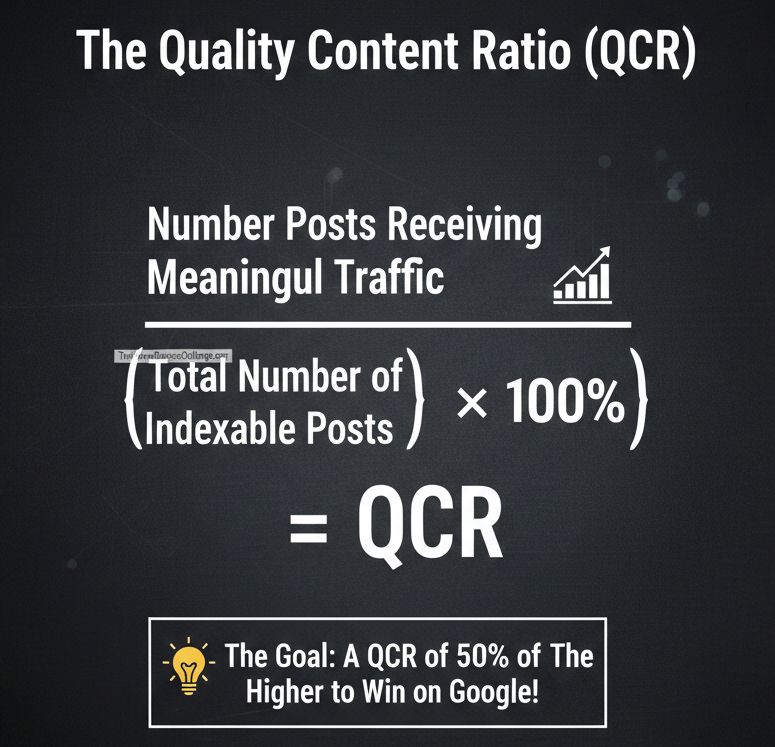
Simply put, your QCR is the percentage of your website that is actually "working" for you. It’s the ratio of your winning posts (the ones getting meaningful traffic) versus your total number of indexed pages.
Here is the formula we’re going to use:

The Reality Check
Let’s say you have 100 blog posts.
- 10 of them are rockstars bringing in 95% of your traffic.
- 90 of them are "ghost towns" that haven't seen a visitor since the day you posted them.
Your QCR is 10%.
In Google's eyes, your site is 90% "clutter." When you try to publish a new, amazing post, Google looks at that 10% track record and thinks, "Eh, there’s a 90% chance this new post is also going to be clutter. Let's put it on Page 8 for now."
The Goal: We want to get your QCR to 50% or higher.
When more than half of your site is consistently providing value and attracting visitors, Google starts to view you as a "High-Signal" authority. You become a trusted source. Suddenly, when you hit "Publish," Google gives you the benefit of the doubt and pushes you toward the top much faster.
Why "Meaningful" Traffic?
I’m not talking about that one time your mom clicked your link (hi, Mom! 👋). I’m talking about consistent, organic clicks from people searching for solutions. If a post hasn't earned a single organic click in 6 months, it’s not a player—it’s a benchwarmer.
Section 3: The Content Audit — Finding Your "Ghost Towns"
Alright, it’s time to roll up our sleeves. To fix your ratio, you first need to know which posts are your "MVPs" and which ones are just taking up space.
We aren’t going to guess. We’re going to use the our best friend: Google Search Console (GSC). If you don’t have GSC set up yet, stop everything and do it now. It’s free, it’s directly from Google, and it’s the only way to see exactly how the world’s biggest search engine views your site.
The 3-Step "Ghost Town" Hunt
- Set the Date: Open GSC, go to "Search Results," and set your date range to the last 6 months. This gives you enough data to see a pattern without getting bogged down by old history.
- Filter by Pages: Click on the "Pages" tab. This will show you every single URL on your site that Google has shown to a human being.
- Sort by Clicks: Click the "Clicks" column to sort it from lowest to highest.
The "Red Zone" List Scroll to the bottom of that list. See all those pages with 0, 1, or 2 clicks over the last half-year? Welcome to the "Red Zone."
These are your benchwarmers. These are the pages dragging down your Quality Content Ratio.
Becca’s Pro Tip: Don't panic if you see a lot of them! Most sites have a long "tail" of low-traffic content. The goal isn't to be perfect; the goal is to be intentional.
What to look for:
- Old "Updates": Short posts about a sale from 2024 or a holiday greeting.
- Thin Content: 300-word posts that don't really answer a question.
- Keyword Cannibalization: Three different posts that all try to answer the same question (e.g., "What is SEO?", "How SEO works", and "SEO basics").
Now that you have your list of culprits, we aren't just going to start deleting randomly. We need a strategy.
Section 4: The Framework — Kill, Combine, or Kindle
Now that you have your "Red Zone" list from Google Search Console, it’s time to play judge, jury, and (sometimes) executioner.
We aren't just deleting for the sake of deleting. We are optimizing. For every post with near-zero traffic, you have three choices. I call this the "Kill, Combine, or Kindle" framework.
1. Kill (The "Mercy" Delete)
If a post is old, thin, or completely irrelevant, it’s time to let it go.
- The Criteria: It’s under 400 words, it’s about a defunct tool, or it’s a "happy holidays" post from 2023.
- The Action: Delete the post and set up a 301 redirect to your homepage or a related category page.
- The Result: You instantly remove "dead weight" from your site, raising your QCR.
2. Combine (The "Super-Post" Merger)
Sometimes you have three "okay" players that would be much stronger as one superstar.
- The Criteria: You have three short posts like "What is a backlink?", "How to get backlinks", and "Why backlinks matter." None of them are ranking well because they are too "thin."
- The Action: Take the best parts of all three, combine them into one massive Ultimate Guide to Backlinks, and delete the three old ones.
- The Scrappy Tip: Redirect the old URLs to the new "Super-Post." This tells Google, "Hey, all that small authority I had is now concentrated right here."
3. Kindle (The "Makeover" Refresh)
This is for the posts that are so close to being winners.
- The Criteria: Look at your Search Console data. Does a post have a lot of impressions (people are seeing it) but very few clicks? That means Google wants to show it, but your title or meta description isn't enticing enough for people to click.
- The Action: Give it a makeover. Update the title to something more punchy and helpful, refresh the intro, and add a new image.
- The Result: You "re-light" the fire on a post that was almost dead.
Example:
Remember my HBA vs. ClickFunnels breakdown? I could have written five tiny posts about pricing, speed, and features. But I knew that would tank my QCR. Instead, I combined everything into one high-value comparison. One winner is better than five benchwarmers every single time! 🥂✨
How are we feeling about the pruning process? It’s a bit of work upfront, but the payoff for your rankings is massive.
Section 5: The SEO Math — Why the Ratio Matters to Google
By now, you might be thinking, "Becca, why does it matter if I have 100 pages or 1,000 pages? Storage is cheap, right?" Well, it’s not about storage—it’s about attention. Even Google has a limit on how much energy it spends on your site. This is where the "scrappy" math meets the "techy" side of SEO.
1. The "Crawl Budget" Problem
Google uses "crawlers" (automated bots) to scan your site. But Google doesn't give every site an unlimited pass. They give you a Crawl Budget.
If your site is 90% "dead weight," Google’s bot spends 90% of its time crawling old, useless pages. That means it might take weeks or even months before it finds your brand-new, high-quality "MVP" post.
By pruning your site and raising your QCR, you ensure that every time Google visits, it only sees your best work. You’re essentially clearing the tracks so your new content can move at high speed. 🚂💨
2. Domain Trust & Authority Density
Think of your "Domain Authority" like a bucket of water.
- If you have 5 massive buckets (high-quality posts), your authority is concentrated and deep.
- If you try to pour that same water into 500 tiny thimbles (thin, low-quality posts), it evaporates.
Google evaluates your site as a whole. When your QCR is high, Google trusts your domain more. You start to earn what I call "Authority Density." This is the secret sauce that allows small, scrappy blogs to outrank massive corporate sites. They might have more pages, but your ratio is better. Your "win rate" is higher.
3. The "Helpful Content" Signal
Google’s recent updates are all about "Helpful Content." If Google sees that most of your pages are "unhelpful" (meaning they don't get traffic or solve problems), it applies a sitewide penalty.
Fixing your QCR is the fastest way to send a signal to Google that says: "I’m not a content farm. I’m a high-value authority."
Becca’s Pro Tip: You don't need a huge site to make huge money. A site with 30 high-performing posts will always make more than a site with 3,000 ignored posts. Focus on the density, not the volume! 🥂✨
Section 6: The Success Roadmap — Your 30-Day Ratio Fix
I don’t want you to just read this and feel inspired; I want you to take action. Fixing your Quality Content Ratio isn’t an overnight job, but it doesn’t have to take all year, either.
If you commit to this 30-Day Ratio Fix, you’ll clear the clutter and give your site the "SEO breath of fresh air" it’s been begging for.
Week 1: The "GSC" Deep Dive
- The Goal: Data collection.
- The Action: Spend 30 minutes in Google Search Console. Export your list of pages from the last 6 months and sort them by clicks.
- My Pro Tip: Highlight every post with fewer than 5 clicks in red. Don’t judge them yet—just identify them.
Week 2: The "Kill" & "Combine" Phase
- The Goal: Aggressive pruning.
- The Action: Go through your "Red" list. Delete the fluff (the "Kills") and group the related topics together for merging (the "Combines").
- My Pro Tip: Set up your 301 redirects as you go. If you’re on Squarespace or WordPress, there are free plugins (or built-in settings) that make this a 5-second task.
Week 3: The "Kindle" Makeover
- The Goal: Polishing the "almost-winners."
- The Action: Pick the top 5 posts from your list that have high impressions but low clicks. Rewrite the titles and update the meta descriptions.
- My Pro Tip: Ask yourself: "If I saw this title on Page 1, would I actually click it?" If not, keep digging for a better hook!
Week 4: The "High-Signal" Content Push
- The Goal: Adding quality back into the mix.
- The Action: Instead of writing three new posts, spend this week writing one high-quality, long-form post that targets a specific "Hero" keyword.
- My Pro Tip: Now that your site is cleaner, this new post has a much better chance of ranking quickly!
The Result
By the end of these 30 days, your website won't just look better to you—it will look authoritative to Google. You’ve stopped the "dead weight" from dragging you down, and you’ve shown the "Talent Scout" that your team is ready for the big leagues. 🥂✨
Conclusion: Less Content, More Authority
The "Tech Tax" isn't just about the money you pay for software; it's also the "Time Tax" you pay when you create content that doesn't work for you.
Being an Entrepreneur means working smarter, not harder. It means knowing when to hold 'em and when to fold 'em. By mastering your Quality Content Ratio, you’re taking control of your SEO destiny. You’re building an asset that actually grows.
[Click Here to Download my QCR Audit Spreadsheet] — I’ve made it super simple to plug in your GSC data and see your ratio instantly. Let’s get to pruning! 🥂✨
 No more wasting time learning – let’s start doing! My name is Becca and I’m your new digital BFF! 🙂 Let’s crush our side hustles together!
0 Comments