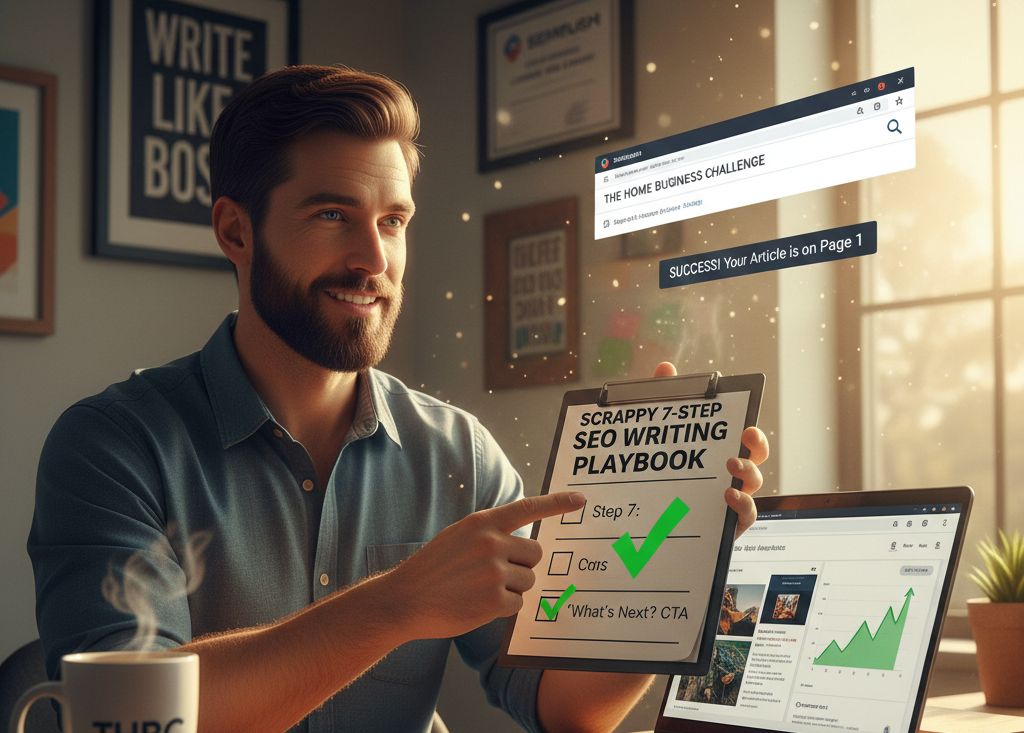
Let’s be real: most of the writing advice you find online is either too "creative writing 101" or so bogged down in technical SEO jargon that it makes your head spin. You’re told to "just write great content," but then you watch as AI-generated fluff or corporate giants with massive budgets steal the top spots on Google. It’s frustrating, and it’s the #1 reason many entrepreneurs give up on blogging before they ever see their traffic start to grow.
The truth is, you don’t have to choose between writing for humans and ranking for robots. In 2026, the secret to better writing and increased rankings is a simple approach - writing with a personality that builds instant trust and that tells Google exactly where you belong.
You want your readers to feel like they’re having a coffee with an expert, while the search engines see you as the undisputed authority in your niche.
In this guide, I’m pulling back the curtain on how I balance these two worlds. I’ll show you how to "Write Like a Pro" by focusing on the human connection and "Rank Like a Boss" using my Sidekick Keyword strategy.
Whether you're a seasoned specialist or just starting your home business challenge, it’s time to stop shouting into the void and start owning the front page. 🥂✨

At The Home Business Challenge, I believe in being a practitioner, not just a theorist. That’s why I disclose that I am an affiliate for several tools mentioned in my guides. When you use my links, you’re helping support my work in finding the best "Survival" strategies for home businesses. I’m an Amazon Associate and an affiliate for brands I trust. I’ll always give you my honest take, regardless of the commission, because your trust is my most valuable asset.
Step 1: Find Your "Hero" Keyword (and some Sidekicks)
Before you type a single word, you need to know who you’re talking to.
In the world of SEO, we don’t just write into the void—we write to answer a specific question for a specific person. I like to call your main topic the "Hero" Keyword. This is the one big, juicy phrase that defines the heart of your article. For example, if you’re writing about morning routines, your Hero might be "Life-Changing Morning Routine." Everything in your post should serve that Hero!
But a Hero can’t do it alone—they need a team! That’s where your "Sidekick" Keywords come in. These are 2-5 related phrases or questions that people also search for.
If our Hero is the morning routine, our Sidekicks might be "morning habits for success" or "how to wake up early." These help Google understand the full "neighborhood" of your topic, making your article feel well-rounded and authoritative rather than just a one-trick pony.
Becca’s Pro Tip: You don't need a degree in data science for this. Just type your Hero keyword into Google and scroll down to the "People Also Ask" or "Related Searches" section at the bottom. Those might be some of your Sidekicks! Grab a few that feel natural, and you’ve got a roadmap for your content before you’ve even finished your first cup of coffee. ☕✨
Step 2: The "Scroll-Stop" Headline
You could write the best article in the world, but if the title is boring, no one will ever see it.
You could write the most brilliant, life-changing article in history, but if your headline is a snooze-fest, nobody is ever going to click it. Think of your title as your digital billboard on a very crowded highway. You have about half a second to catch someone's eye before they zoom right past you. 🏎️💨
A "Scroll-Stop" headline does two things: it promises a transformation and it uses emotional hooks. Instead of a dry, textbook title like "Ways to Improve Your SEO," we want something with a little more "hustle." Try something like "The Scrappy Guide to SEO: How to Rank Without a Huge Budget." See the difference? One sounds like a chore; the other sounds like a secret weapon.
The "Becca" Formula for Magnetic Titles:
- The Number Hook: "7 Steps to..." or "5 Mistakes that..." (People love a list!)
- The Power Word: Use words like Scrappy, Effortless, Ultimate, or Secret. * The Result: Tell them exactly what they’ll get. "Rank on Page 1" or "Write Articles People Actually Read."
Becca’s Pro Tip: Don’t just settle on the first title you think of. Write down ten different versions and see which one makes you want to click. If it doesn't make you feel a little bit excited, it’s not ready yet! 🥂✨
Step 3: Hook 'Em in the First Paragraph
The first 50 words of your article are the "make or break" zone. If you start with a dry definition or a long-winded history lesson, your reader is going to hit the "back" button faster than you can say "bounce rate." 🏃💨
Keep them on the page!
The goal here is to make your reader feel seen. Start by acknowledging their struggle—maybe they’re tired of writing posts that get zero views, or they’re overwhelmed by all the "techy" SEO talk. When you say, "I’ve been exactly where you are," you build instant trust. You aren't a corporate lecturer; you’re a mentor who has already cleared the path. Use the word "You" more than the word "I." This tells the reader that this article is about their success, not your ego.
Becca’s Pro Tip: Try starting with a question that hits their biggest pain point. Something like, "Ever feel like you're shouting into a digital void?" It forces them to nod their head and say, "Yes! That's me!" Once you’ve got that "yes," tell them exactly how this article is going to solve that problem. Give them a reason to keep scrolling! 🥂✨
Step 4: Use the "SEO Skeleton" (H2s and H3s)
Google (and your readers) love structure. Break your article up with clear subheadings (H2s and H3s). This makes your post "scannable." Most people don't read every word; they scan the headings to find the part they need. Make sure your Hero keyword makes an appearance in at least one subheading!
Structure is everything! Think of your article like a house: the H1 is your front door (the title), but your H2s and H3s are the rooms that make the house livable. Most readers today are "scanners"—they won't read every single word, but they will scan your subheadings to find the specific answer they're looking for. If you give them a "wall of text" without any breaks, they’re going to get overwhelmed and leave.
But subheadings aren't just for humans; they’re for the Google robots, too! 🤖 These headers act as an "SEO Skeleton" that tells search engines exactly how your content is organized. When you put your "Hero" or "Sidekick" keywords into an H2 or H3, you’re basically highlighting them in neon for Google. It’s like saying, "Hey! This section right here is specifically about [Your Topic]!" It makes your site much easier to index and rank.
Becca’s Pro Tip: Every time you switch to a new idea or a new tip, give it its own H2. If that tip has multiple parts, use H3s. A good rule of thumb? If you haven't seen a bold subheading in two or three paragraphs, it’s time to add one! It keeps the reader moving down the page and gives them "mini-wins" as they go. 🥂✨
Step 5: Write Like You Talk (No Fluff Allowed)
Throw out the corporate "textbook" talk. Use "I" and "you." Be relatable. If you wouldn't say it to a friend over coffee, don't put it in your article. Short sentences and short paragraphs are your best friends—they keep the energy high and the reader moving down the page.
Throw that corporate "textbook" talk out the window! 🪟 When you write for your business, you want to sound like a real person, not a legal disclaimer. The biggest mistake writers make is thinking they need to sound "professional" by using big words and long, winding sentences. In reality, that just makes people's eyes glaze over.
Keep your sentences punchy and your paragraphs short. I love using one-sentence paragraphs to make a point.
Like that. 🙂
It creates "white space" on the screen, which makes your content feel lighter and easier to breathe in. Use "I" and "you" to keep the conversation personal.
When you share a little bit of your own personality—even a dorky joke or a "been there" mistake—you aren't just giving information; you're building a relationship.
Becca’s Pro Tip: Read your draft out loud. 🗣️ If you find yourself running out of breath or tripping over a sentence, it’s too long! Cut the "fluff" words (like actually, basically, or virtually) and get straight to the point. Your readers are busy; they’ll love you for respecting their time by being clear and direct. 🥂✨
Step 6: The "Picture-Perfect" Boost
A wall of text is a one-way ticket to a high bounce rate. Add images, charts, or screenshots every few hundred words.
Every time you upload an image, you have the chance to fill out something called "Alt Text." This is a short description that tells Google (and visually impaired readers) what the image is about.
Since Google’s robots can't "see" a photo of your morning coffee, the Alt Text is how they understand the context of your post.
If you’re writing about morning routines and you have a photo of a journal, your Alt Text shouldn't just be "Notebook." It should be something like "Daily journaling habit for a life-changing morning routine."
Becca’s Pro Tip: You don't need a professional photographer or an expensive stock photo subscription! Some of the best-performing images are just simple, "real-life" photos taken on your phone. Whether it’s a shot of your messy desk or a quick snap of your morning coffee, authenticity builds more trust than a polished corporate photo ever will. Just keep it real! 🥂✨
Step 7: The "What's Next?" Call to Action (CTA)
Never leave your reader hanging! At the end of every post, tell them exactly what to do next. Do you want them to sign up for your newsletter? Buy your book on Amazon? Or read another related post? A good CTA turns a "visitor" into a "loyal fan."
Every single post should have a Call to Action (CTA). This is where you turn a casual reader into a loyal fan or a customer. It doesn’t have to be a pushy sales pitch! It can be as simple as asking them to leave a comment with their own tips, inviting them to check out your book on Amazon, or pointing them toward another article they’ll love.
Think of it as the "What's Next?" in your partnership.
Becca’s Pro Tip: Don't give them ten options, or they’ll pick zero. Pick one main action you want them to take. If it was about morning routines, tell them to go grab your book! By giving them a clear next step, you’re keeping them inside your world and moving them one step closer to crushing their own home business challenge. 🥂✨
 No more wasting time learning – let’s start doing! My name is Becca and I’m your new digital BFF! 🙂 Let’s crush our side hustles together!
0 Comments