
There's a bit of an art to finding the right keywords that will rank in Google. And if you thought it was tricky before, it's another level of tricky today with AI search results.
I know it's a lot, but you have me now to help you through this. 🙂 I wish Semrush had a timer on it to tell me how many hours I've spent doing keyword research over the years. There was one client I worked for who had an enormous website. I probably spent twenty hours alone doing keyword research for them and building the biggest topical map ever. Haha.
So, before we dive in, take a breath. I've got you.
If you feel like you’re drowning in data, chill out for a second. We’re going to pull you out of the vortex and back to the basics.
Even though I've spent over ten years as an SEO specialist, I don’t believe in being a theorist. And I'm not very analytic either. I’m a doer. Does that make me a bad SEO? Haha.
I learn what I need to learn, know what I need to know. And then do what I need to do. I didn't take chances on theoretical SEO because I never needed to. I always found great results for my clients by doing the right things.
I also know exactly how it feels to stare at a blank spreadsheet wondering how on earth to get Google to notice you. That’s why I’ve broken this down into five simple, repeatable steps to help your business get the visibility it needs to really take off - by finding the right keywords!
At The Home Business Challenge, I believe in being a practitioner, not just a theorist. That’s why I disclose that I am an affiliate for several tools mentioned in my guides. When you use my links, you’re helping support my work in finding the best "Survival" strategies for home businesses. I’m an Amazon Associate and an affiliate for brands I trust. I’ll always give you my honest take, regardless of the commission, because your trust is my most valuable asset.
Step 1: Gather Those Keywords
Did you ever get that one writing assignment in school where they told you to just "write whatever comes to mind." This is called uninhibited writing, and it’s a powerhouse move for sourcing keywords.
First, sit down, picture your ideal customer, and list out every word that comes to mind—no matter how vague or strange. I know this isn't easy because I never had a client who enjoyed this or had much patience for this step. But don't skip it! Really take some time to think about this. You'll thank me later.
Once you have that "free-spirited" list, it’s time to tame it. We’re going to divide those words into four specific buckets:
- Seed Words: These are broad terms that describe your service (e.g., "handmade soap" or "marketing coach").
- Already Working Words: If your site has been live for more than a few weeks, head over to Google Search Console (if you haven't set this up yet, stop everything and do it now). Look at the "Performance" tab to see which words are actually bringing people to your door right now.
- Competitor Ranking Words: Your competitors are already winning somewhere. Use a tool like SEMrush or Ahrefs to "peek" at their homework. Plug in their URL, and these tools will show you exactly which keywords are driving their traffic.
- Discard Words: Be honest—some of those brainstormed words like "cool stuff" or "help" are too wild to be useful. Toss them.
Step 2: Decide How You’re Going to Filter
Now, your list is likely still gargantuan. To trim it down without losing the "gold," we need to define our filtering criteria.
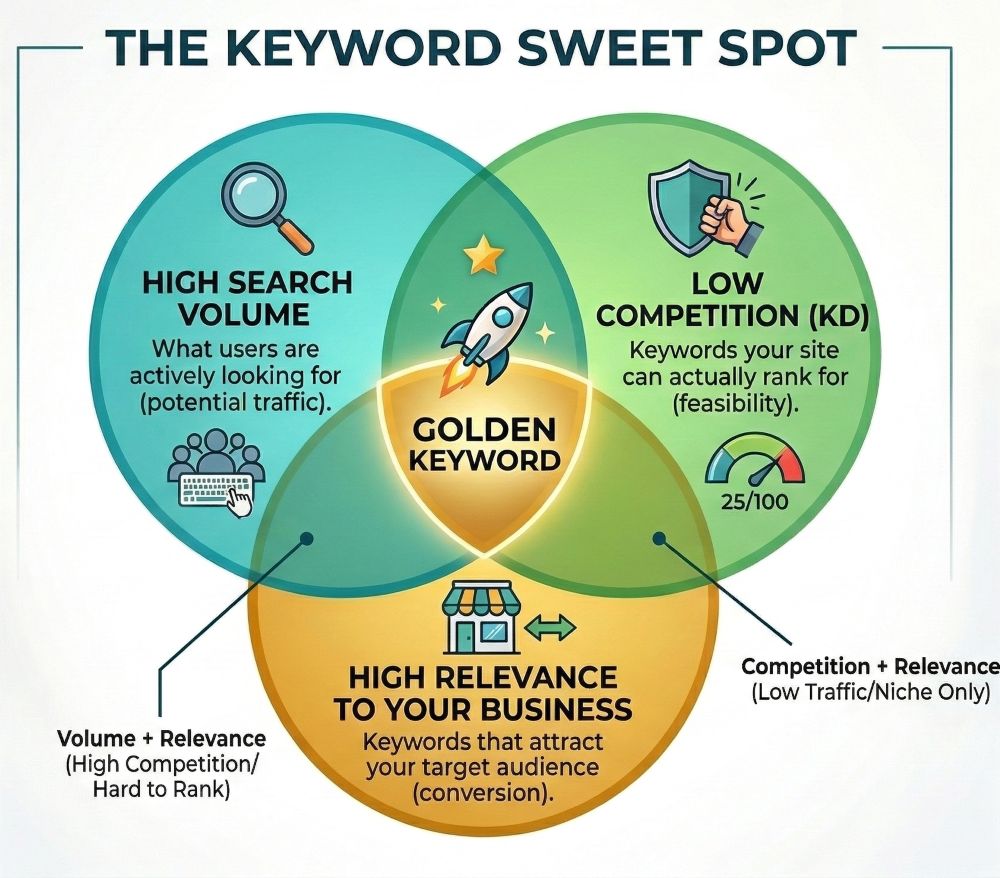
You can’t just guess; you need to look at the three pillars of keyword health:
- Search Volume: This tells you how many people are typing this word into Google every month. The higher the volume, the more potential traffic—but also the more competition.
- Keyword Difficulty (KD): Most SEO tools give you a score from 0 to 100. For a new business, you want to hunt for "Low Difficulty" (usually under 30 or 40) so you actually have a chance to rank on Page 1.
- Word Length (The Long-Tail Secret): Keywords that are 3–5 words long (e.g., "organic lavender soap for sensitive skin") are called Long-Tail Keywords. They usually have lower volume but much higher conversion rates because the searcher knows exactly what they want.
Keyword Strategy Cheat Sheet
| Keyword Type | Search Volume | Difficulty | Your Strategy |
| Broad Seed | High (10k+) | High | Too competitive for now. |
| The Sweet Spot | Medium (100–500) | Low (<40) | Prioritize these! |
| Hyper-Niche | Low (<50) | Very Low | Great for specific blog posts. |
Step 3: Filter, Filter, Filter
Now comes the housekeeping phase. If you've been using a tool like SEMrush or Ahrefs, you’ll notice a "Filter" button near your keyword list. This is your best friend. Instead of scrolling through 1,000 words, you’re going to tell the software exactly what you’re looking for.
As a practitioner, I recommend setting your parameters to weed out the noise that will just waste your time. Start with these benchmarks:
Search Volume: Set the minimum to 50-100 searches per month. You want to make sure someone is actually looking for this.
Keyword Difficulty (KD): Set the maximum to 40 or lower. Remember, as a growing business, you want to pick fights you can actually win.
Word Count: Filter for keywords with 3 words or more. These "long-tail" phrases are easier to rank for and much more specific to your customer's needs.
With one click, your "gargantuan" list will transform into a "Golden 20" or "Golden 50"—a pristine set of words that are actually achievable for your site.
Step 4: Group Them Together (Search Intent)
Now that you have your list, don't just sprinkle them randomly across your site like salt. You need to give them a purpose by understanding Search Intent. Why is the person typing this into Google?
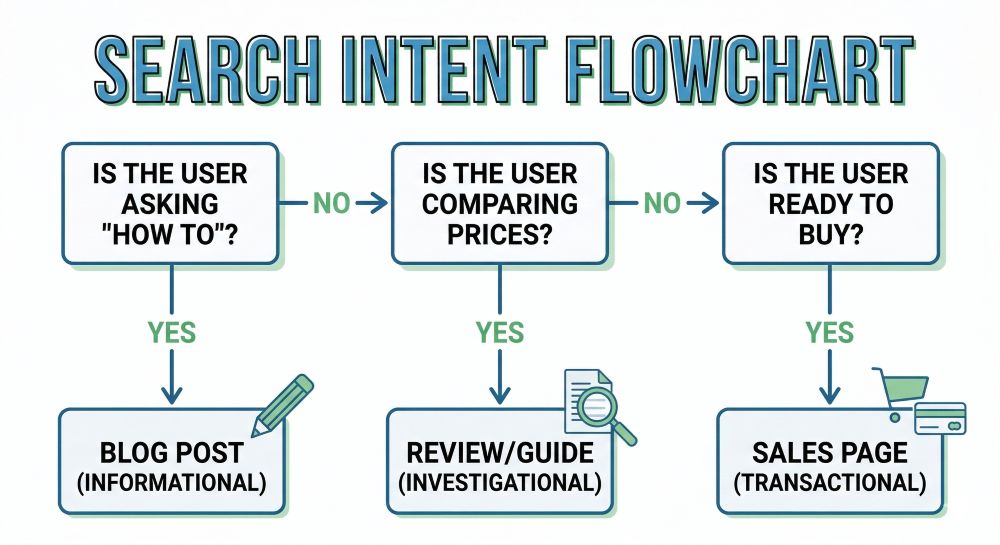
Most searches fall into three categories. Your software (and your own common sense) will help you divide them:
- Informational (The Teacher): These users are looking for an answer.
- Examples: "How to start a home bakery," "Where is the best kind of fabric?"
- Strategy: Use these for blog posts that build your authority.
- Investigational (The Critic): These users are researching and comparing.
- Examples: "SEMrush vs. Ahrefs review," "Best organic soap for eczema."
- Strategy: Use these for comparison guides or "Top 10" lists.
- Transactional (The Buyer): These users are ready to pull out their credit cards.
- Examples: "Buy lavender soap online," "Home business coaching discount code."
- Strategy: These belong on your Product Pages or Sales Pages.
Semantic Grouping
Once you know the intent, group similar words together. If you have "how to bake bread" and "bread making for beginners," don't create two different pages. Group them! Your SEO tool will often have a "Clustering" or "Grouping" feature that does this seamlessly, allowing one page to rank for dozens of related terms.
Step 5: Make Those Maps!

This part of the process is as simple as assigning your freshly grouped keywords to the specific pages of your website. Think of it as creating a GPS for Google’s crawlers.
Using your software’s "Mapping" or "List" feature, you’re going to designate a "Primary Keyword" for each page. For example:
- Your Homepage: Should target your broadest "Seed" keywords.
- Your Blog Posts: Should target your "Informational" clusters (the "How-to" guides).
- Your Product/Service Pages: Should target your "Transactional" and "Investigational" clusters.
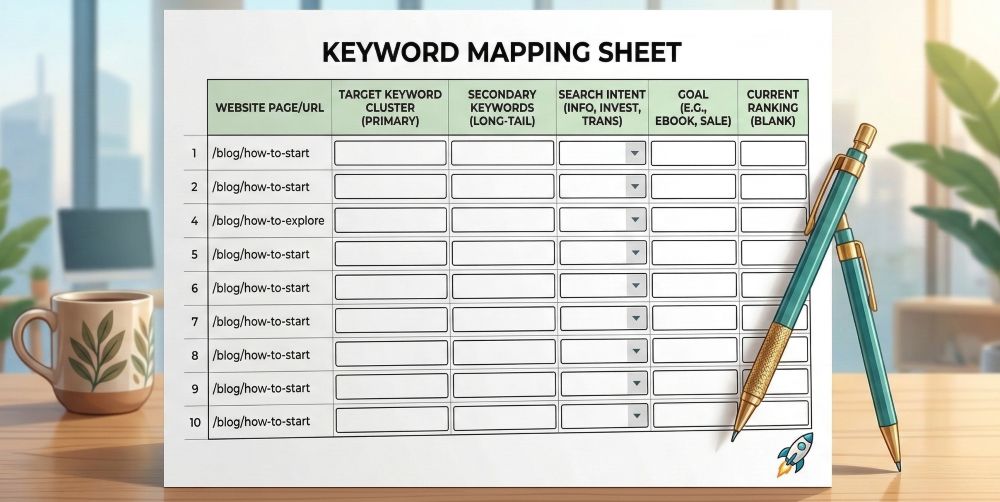
By mapping your keywords this way, you ensure that potential customers land exactly where they need to be. No more frustrated users clicking a link and landing on a generic page when they were looking for a specific solution. It makes your online business more accessible than ever and—more importantly—it keeps people on your site longer.
From Vortex to Victory
If you stick close to these five steps, you’ll be well on your way to building an online business you can be proud of. Here is your "Cheat Sheet" for becoming a keyword wizard (or a keyzard... no?):
- Start Big, Then Prune: Don’t be afraid of a massive initial list. It’s better to have too many ideas and subtract the "fluff" later than to miss out on a hidden gem.
- Prioritize Quality Over Quantity: Use tools like Google Search Console and Semrush to find that "Sweet Spot"—medium volume and low difficulty.
- Give Every Word a Purpose: Group your keywords by Intent. Are they searching to learn, to compare, or to buy? Categorizing your keywords this way allows you to cater to a much wider audience.
- Map It Out: Assign your pristine list of keywords to specific pages. This minimizes customer annoyance and takes them directly to the "checkout" or the "answer" they need.
No matter what you’re selling or what service you provide, mastering these steps will help you optimize your traffic and watch your sales rates soar.
What’s Your Biggest SEO Hurdle?
Keyword research isn't a "one-and-done" task; it's an ongoing conversation with your audience. As you grow, your keywords will evolve, and that’s perfectly okay!
Which of these five steps feels the most daunting to you right now? Or is there a specific tool you’re struggling to wrap your head around? Let me know and let’s troubleshoot your list together!