If you've ever studied a bit of SEO, you probably heard the old mantra:
Content is king, but backlinks are the crown.
For years, the formula for ranking on the first page of Google was simple: get as many links as possible from high-authority websites, and watch your traffic climb. But as we move through 2026, the rules of engagement for link building have undergone a massive shift. It is no longer a simple numbers game; it is a relevance and authority game.
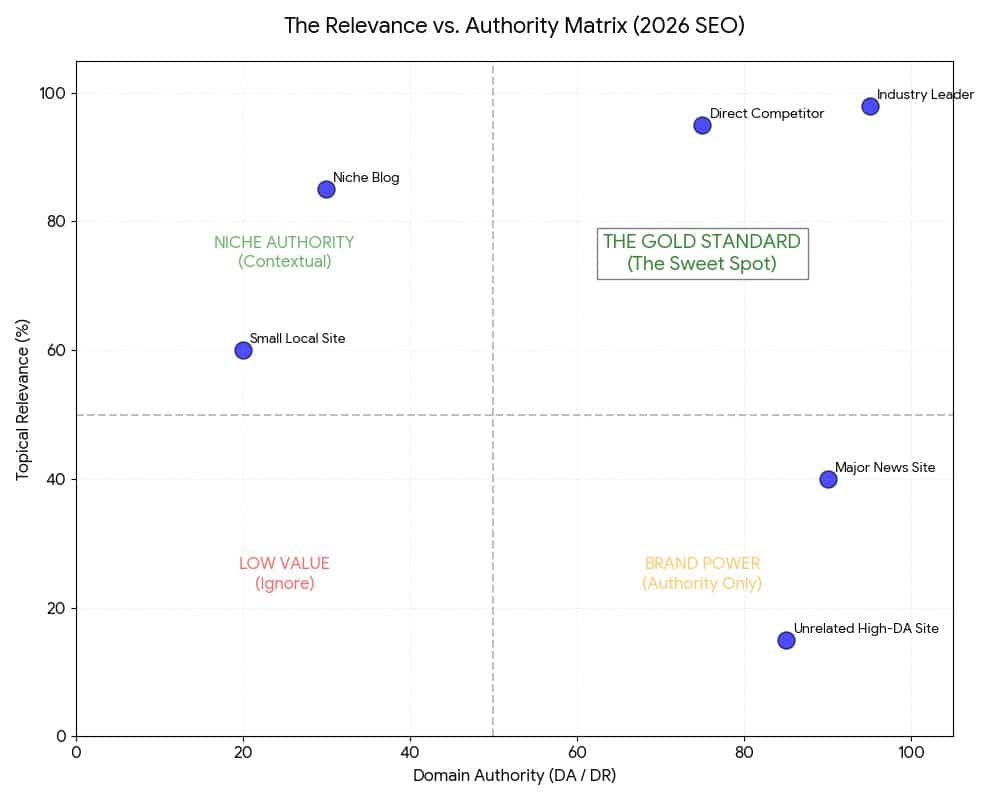
Today, search engines and AI models (like Gemini and ChatGPT) don't just count the number of blue underlined strings pointing to your site. They are looking for context. They want to see your brand mentioned alongside other trusted leaders in your niche. They are looking for co-citations—when your website is discussed in the same breath as industry giants in your niche.

Why High-Quality Backlinks Matter More Than Ever
In the age of AI-driven search, a high-quality backlink does three critical things for your business:
- Trust Signals: It tells Google that a human editor at another reputable site trusts your expertise enough to vouch for you.
- AI Visibility: It helps Large Language Models connect the dots between your brand and specific topics, making it more likely that AI will recommend your site in conversational answers.
- Referral Traffic: Beyond SEO, a link from a relevant site sends actual, pre-qualified customers directly to your content.
Whether you are an author looking to boost your book rankings on Amazon or an entrepreneur scaling an affiliate marketing empire, you cannot afford to ignore your backlink profile. But you also cannot afford to use spammy or outdated tactics that could get your site penalized.
In this guide, we are going to dive into 20 high-impact backlink strategies that work right now. We’ll cover everything from classic techniques like the "Skyscraper Method" to modern, brand-heavy strategies that ensure your business remains visible in the ever-evolving world of search.
Before we dive in, there are a few notes about backlinks I should mention that you should keep in mind:
- The Zero-Link Trend: Over 30% of brand authority now comes from unlinked mentions that AI models use to verify trust. You don't just need backlinks anymore. You need to be mentioned and talked about across the web.
- Success Rates: When you reach out to website or article owners, personalized outreach (addressing the editor by name) has a 5x higher success rate than automated templates.
- The Value of Data: Posts containing original statistics or survey data receive 70% more backlinks than standard "how-to" articles.
- Profile Distribution: Try to have a somewhat balanced backlink profile distribution. If you only focus on one area, such as guest posting, this could look suspicious to Google and not natural. Vary your outreach and backlink strategies.

The "Foundational" Strategies (Classic SEO)
While the SEO landscape shifts, certain "blue-chip" strategies remain the gold standard for building high-quality links. These foundational tactics rely on a simple premise: providing value where it is currently missing. By identifying gaps, broken links, or outdated information on other websites, you position yourself as a helpful partner rather than just another person asking for a favor.
1. The Skyscraper Technique
Popularized by Brian Dean, this remains one of the most effective ways to earn links at scale. The process is a three-step power move:
Step 1: Find a piece of content in the home business or digital marketing niche (or your own niche, of course) that has already earned a high volume of backlinks.
Step 2: Create something better. This could mean making it more up-to-date for 2026, adding better custom visuals, or providing a more complete guide than what currently exists.
Step 3: Reach out to the specific sites that linked to the original (inferior) piece and show them your superior resource.

2. The Moving Man Method
Websites change, businesses rebrand, and resources move. Often, the site owner forgets to update their external links.
How it works: Find a company in your niche that has recently shut down, changed its name (e.g., when SEOMoz became Moz), or stopped updating a specific tool.
The Opportunity: Use a backlink checker (like Semrush) to find everyone still linking to the old, "dead" URL.
The Pitch: Reach out with something like the template below.
Template: The "Moving Man" Outreach
Use this when you find a site linking to a tool, brand, or resource that has moved, rebranded, or shut down.
Subject: Problem with a link on [Their Site Name]
Hi [Name],
I was just reading your article about [Topic] and noticed you mentioned [Old Resource/Brand].
I’m not sure if you’re aware, but [Old Resource] actually [shut down / rebranded / moved] recently. I know how annoying it is when a great post has a "dead" or outdated link, so I thought I’d reach out.
I actually just published a comprehensive, updated guide on [Topic] over at [Your Link]. If you’re looking for a fresh resource to replace that old link so your readers aren't hitting a dead end, it might be a perfect fit.
Either way, keep up the great work with the site!
Best,
Becca
thehomebusinesschallenge.com
3. Broken Link Building
This is the utility version of link building. You aren't just looking for rebranded sites; you're looking for 404 errors.
The Search: Use a tool like Check My Links while browsing high-authority blogs in your niche.
The Value: When you find a broken link, you are doing the webmaster a favor by pointing out an error that hurts their user experience.
The Link: Because you've helped them fix a "bug" on their site, they are significantly more likely to replace that dead link with a link to your relevant content.
Template: The "Broken Link" Outreach
Use this when you find a 404 error on a high-authority blog.
Subject: Quick heads up (Broken link on your site)
Hi [Name],
I was browsing your resources on [Topic] today—really great stuff, specifically the section on [Specific Point].
I did come across one small issue: the link to [Broken Link Title] seems to be dead (404 error).
Since I’m a fan of your content, I wanted to let you know so you could fix it. Also, if you’re looking for a replacement to keep that section helpful for your readers, I recently put together an in-depth piece on [Topic] that covers similar ground: [Link to your post].
Hope that helps!
Cheers,
Becca
thehomebusinesschallenge.com
4. Resource Page Outreach
Many authority sites curate "Resource Pages" or "Recommended Tools" lists for entrepreneurs (like me!). These pages are designed specifically to link out to helpful content.
Finding them: Use Google search strings like inurl:resources "home business" or “useful links” digital marketing.
The Strategy: Don't just ask to be added. Explain why your specific guide or tool adds a unique perspective that their current list is missing.
Pro Tip: When performing outreach for these foundational strategies, personalization is everything. Avoid "template-speak." Mention a specific detail from their article to prove you’ve actually read it.
The "Authority" Strategies (PR & Expert Positioning)
In 2026, search engines and AI models are obsessed with E-E-A-T (Experience, Expertise, Authoritativeness, and Trustworthiness). To rank for competitive terms, it’s not enough to just have great content—you need to be recognized as an authority.
These strategies focus on earned media, where you leverage your personal brand and business expertise to secure mentions on high-profile platforms.
5. Becoming a Source (HARO & Featured)
Journalists at major publications like Forbes, Entrepreneur, and other types of news outlets are constantly looking for expert quotes to round out their stories. By using platforms like Featured.com or HARO (Help a Reporter Out), you can respond to these queries directly.
The Goal: Provide a punchy, 2-3 sentence insight that a journalist can copy and paste.
The Result: A high-authority backlink from a news site that is nearly impossible to get through traditional outreach.
6. Podcast Guesting
Podcasting has exploded as a networking and SEO tool. When you appear as a guest on a podcast in your niche, the host will almost always create a "Show Notes" page on their website.
The SEO Value: These pages typically include a bio and a direct link to your site.
The Networking Bonus: It introduces your brand and website to a completely new, engaged audience.
7. Collaborative Expert Roundups
Instead of waiting to be asked for a quote, you can be the curator. Reach out to 10–15 influencers in your niche and ask them one specific question (e.g., "What is your #1 tip for starting a business in 2026?").
The Strategy: Once you publish the roundup, let the experts know.
The Link Bait: Most experts will share the post with their audience or link to it from their Press or As Seen In pages because it highlights their expertise.
8. Testimonials for Tools
Think about the software and tools you use every day to run your business—whether it's a WordPress hosting provider, an SEO plugin like Link Whisper, or a keyword research tool.
The Pitch: Most SaaS (Software as a Service) companies have a "Testimonials" or "Success Stories" section.
The Win: Reach out to their marketing team with a glowing, detailed review of how their tool helped you grow. They often link back to your site to prove you are a real customer, giving you a high-authority homepage link.
Expert Insight: When positioning yourself as an authority, focus on the unique data or results you've achieved. Instead of saying "I know SEO," say "I increased my affiliate revenue by 40% using these three specific steps." Specificity builds trust with both editors and readers.
The "Asset-Based" Strategies (Earning Links Passively)
The most sustainable way to build a backlink profile is to create content that is so valuable, so unique, or so useful that people link to it without you ever having to ask. In SEO terms, these are called "Linkable Assets." By shifting your focus from promoting to providing, you create a fly-wheel effect where your site earns authority while you sleep.
9. Citation Magnets (Data & Statistics)
Bloggers and journalists love to back up their claims with hard numbers. If you can provide those numbers, you become the primary source.
The Strategy: Conduct a survey of your readers or fellow people in your niche about their biggest challenges in 2026.
The Result: When another writer wants to say, "72% of digital entrepreneurs struggle with AI content balance," they will link to your study as the proof.
10. Free Tools & Calculators
Interactive content is one of the highest-converting link assets. A simple tool that solves a specific problem for your audience can generate thousands of passive links over time.
Examples: An "Affiliate Commission ROI Calculator," a "Book Royalty Estimator," or a "Domain Name Value Checker."
Why it works: People bookmark tools and share them in forums like Reddit or niche Facebook groups because they provide immediate utility that a static blog post cannot.
11. Ultimate Guides & Pillar Content
A "Pillar Post" is a comprehensive, long-form resource that covers every aspect of a specific topic (e.g., The 10,000-Word Guide to Starting an SEO Business from Home).
The Goal: To become the "Wikipedia" of that sub-topic.
The SEO Value: Because the guide is so thorough, other bloggers will link to your "Pillar" instead of trying to explain the entire topic themselves. They might say, "For a deeper dive into keyword research, check out this [Ultimate Guide]."
12. Branded Strategies (The "Name It" Technique)
One of the secrets to Backlinko’s massive success was naming his strategies (like the "Skyscraper Technique"). When you give a specific process a catchy, branded name, you create a new "entity" in the eyes of search engines.
So far, I've only come up with the Quality Content Ratio. Hopefully it takes off! 🙂
How to apply it: Take a unique twist you use for your Amazon book launches or SEO audits and give it a name—like the "24-Hour Authority Flip."
The Outcome: As people find success with your method, they will refer to it by name in their own blog posts and YouTube videos, naturally linking back to the original source.
Pro Tip: When creating these assets, make sure they have their own dedicated, clean URL. A tool or a massive guide buried in a sub-menu is harder for people to link to. Give these "Magnets" the spotlight they deserve on your navigation bar.
The "Modern & Creative" Strategies (2026 Tactics)
The SEO landscape in 2026 requires more than just "outreach." As AI-driven search results prioritize brand authority and actual human engagement, your link-building needs to be more integrated and creative. These strategies move beyond traditional "link hunting" and focus on building a digital footprint that search engines—and AI models—can’t ignore.
13. Strategic Guest Posting (The Relevance First Approach)
In the past, guest posting was about volume. Today, it’s about placement. Instead of writing for any site that will take you, target websites that already rank for the keywords you want to own.
The Strategy: Use a tool like Semrush to find blogs ranking in the top 10 for a keyword you want to rank for.
The Goal: By getting a guest post on a high-ranking page, you inherit some of that page's topical authority, signaling to AI models that your brand is a trusted peer.
14. Launching an Affiliate Program
While often viewed as a sales tactic, a well-run affiliate program is a powerful link-building engine. When you offer a commission for your books or digital services, you incentivize thousands of creators to build content about you.
The Result: You'll naturally earn links from product reviews, "Top 10" lists, and "Tools I Use" pages across the web.
The AI Advantage: These widespread mentions help seed the training data for LLMs, ensuring your business is cited when users ask for the product or service you provide.
15. Reclaiming Unlinked Brand Mentions
As your business grows, people will start talking about you. They might mention your website or your Amazon books in a blog post but forget to include a link.
The Process: Set up a Google Alert or use a tool like Mention for [your name] and [your brand name].
The Outreach: Send a friendly note to the author: "Thanks so much for the shout-out! I’m glad you found my strategy helpful. Would you mind making the name a clickable link so your readers can find the original guide easily?"
16. Image Attribution (The Infographic Reverse-Search)
If you create original diagrams, charts, or book cover art, other people will likely use them in their own blog posts or social media.
The Tactic: Perform a Google Lens or reverse image search on your unique assets once a month.
The Claim: If you find your image on another site without a credit, reach out and ask for a simple attribution link. Most webmasters are happy to comply to avoid copyright issues.
Expert Insight: In 2026, Co-occurrence is just as important as the link itself. Even if a mention is "no-follow," having your brand name appear next to high-value keywords helps search engines understand exactly what your business is an authority on.
The Engagement Strategies (Community & Influence)
In 2026, SEO is no longer a "set it and forget it" technical task. Search engines now prioritize user signals and social proof. If people are talking about your site on Reddit, sharing your strategies on LinkedIn, or citing your books in professional communities, Google and AI models take notice. These strategies focus on building "buzz" that translates into high-quality, natural backlinks.
17. Leveraging Listicles (The "Best of" Outreach)
Search for your primary keywords followed by "best of" or "top blogs" (e.g., “Best home business blogs 2026”). These articles are already ranking well and driving targeted traffic.
The Pitch: Reach out to the author with a personalized note. Don't just ask to be added; show them a specific post of yours that provides more value than the ones currently on their list.
The Value: Being added to an existing, high-ranking listicle provides immediate referral authority and a boost in your topical relevance.
18. Helping Outdated Content (The Editor's Friend)
Many high-authority sites have older posts that still rank well but contain outdated information, dead screenshots, or old stats from 2022 or 2023.
The Strategy: Find a popular but aging post in your niche.
The Offer: Reach out to the editor and offer to write a fresh 200-word "2026 Update" paragraph or provide a new custom chart in exchange for a simple "contributor" backlink. Most editors are spread thin and will appreciate the free, high-quality update to keep their rankings alive.
19. Ego Bait (Strategic Mentions)
This is the art of giving to get. When you write a post on your site, naturally mention and link to influencers, authors, or tools that you genuinely admire.
The Follow-up: Once the post is live, send a quick "FYI" email or tag them in a LinkedIn post: "Hey [Name], just wanted to let you know I featured your [Book/Tool] as a top resource in my latest guide. Thanks for the inspiration!"
The Result: Frequently, these influencers will return the favor by sharing your post with their massive audience or adding you to their "Recommended" or "Press" pages.
Template: The "Ego Bait" Follow-up
Use this after you’ve published your post and mentioned an influencer or a tool like Link Whisper.
Subject: You're featured! (yoursite.com)
Hi [Name],
I’ve been a big fan of [Their Work/Tool] for a while now, so I wanted to let you know that I featured you as a top resource in my new guide: [guide name].
You can check out the mention here: [Link to your post]
Thanks for consistently putting out such helpful [content/software]—it’s been a huge help for my business. If you feel like sharing the post with your audience, I’d be honored!
Best,
Becca
20. Forum & Community Value (Reddit & Quora)
While many community links are no-follow, they are goldmines for AI discovery. When you provide a deep, insightful answer to a question on a subreddit like r/entrepreneur or r/selfpublish, you are seeding the "knowledge graph" that AI models use.
The Method: Don't spam links. Provide 90% of the value in the comment itself, then drop a link to your site as a "For those who want the full step-by-step checklist, I wrote a deeper dive here."
The Benefit: If your comment gets upvoted, it signals to search engines that your content is authoritative and highly relevant to that specific topic.
Expert Insight: High-engagement links from active communities often drive more actual sales and conversions than a "hidden" link on a high-DA news site. Focus on where your customers are actually hanging out.
Building Your Authority
Link building in 2026 is no longer about "tricking" an algorithm; it is about demonstrating your value to the entire digital ecosystem. Whether it is a human reader looking for a solution or an AI model looking for a trusted source to cite, your goal is the same: to be the most relevant, high-quality answer to their question.
By implementing these 20 strategies, you aren't just "building links"—you are building a brand. You are moving from being just another website to being a recognized authority in the entrepreneurship and SEO space.
Your 30-Day Action Plan
Don't try to tackle all 20 strategies this afternoon. Instead, follow this structured rollout to see the best results without burning out:
- Week 1: The Low-Hanging Fruit. Start by setting up your Google Alerts for Brand Mentions (Strategy 15) and your profiles on Featured.com (Strategy 5). These require the least "content creation" and can yield high-authority links quickly.
- Week 2: The Audit. Spend this week using a broken link checker or a backlink tool to find Moving Man (Strategy 2) or Broken Link (Strategy 3) opportunities in your specific niche.
- Week 3: The Asset Build. Choose one "Linkable Asset" to create. This could be an Ultimate Guide (Strategy 11) or a simple Free Tool (Strategy 10). This is your long-term "passive link" engine.
- Week 4: The Outreach. Now that you have a high-quality asset, reach out to the contacts you identified in Week 2. Use the Skyscraper Technique (Strategy 4) to show them why your new guide is the best resource for their readers.
Consistency Over Intensity
The most successful websites aren't those that build 1,000 links in a month and then stop. They are the sites that earn 5 to 10 high-quality, relevant mentions every single month, year after year.
Focus on Relevance First. A single link from a well-respected marketing blog will do more for your rankings and your "AI visibility" than a hundred links from unrelated sites.
<3 Becca