The landscape of video discovery has fundamentally shifted. In the early days, YouTube SEO was a game of "keyword stuffing"—tagging your video with every related term and hoping for the best. Today, the algorithm has evolved into a sophisticated discovery engine powered by deep learning and viewer satisfaction signals.
The Paradigm Shift: From Gaming to Serving
The most critical realization for any creator in 2026 is that YouTube does not find viewers for videos; it finds videos for viewers.
The goal of the algorithm is to keep users on the platform by showing them content they will actually enjoy and finish. While keywords still help the system categorize your video, high rankings are now earned through Satisfied Watch Time.
If your metadata promises a solution but your retention graph shows viewers dropping off in the first ten seconds, no amount of SEO tricks will keep you at the top.
Search vs. Browse: Two Paths to Growth
To master YouTube SEO, you must understand that your traffic will generally come from two distinct funnels:
YouTube Search: Driven by intent. Users type a specific query (e.g., "how to set up a WordPress site") and look for a direct answer. This is the foundation for evergreen growth and affiliate conversions.
Browse (Home & Suggested): Driven by interest. YouTube pushes your video to people based on their past behavior. SEO here is less about the "search term" and more about the CTR (Click-Through Rate) and Topic Authority.
AEO (Answer Engine Optimization)
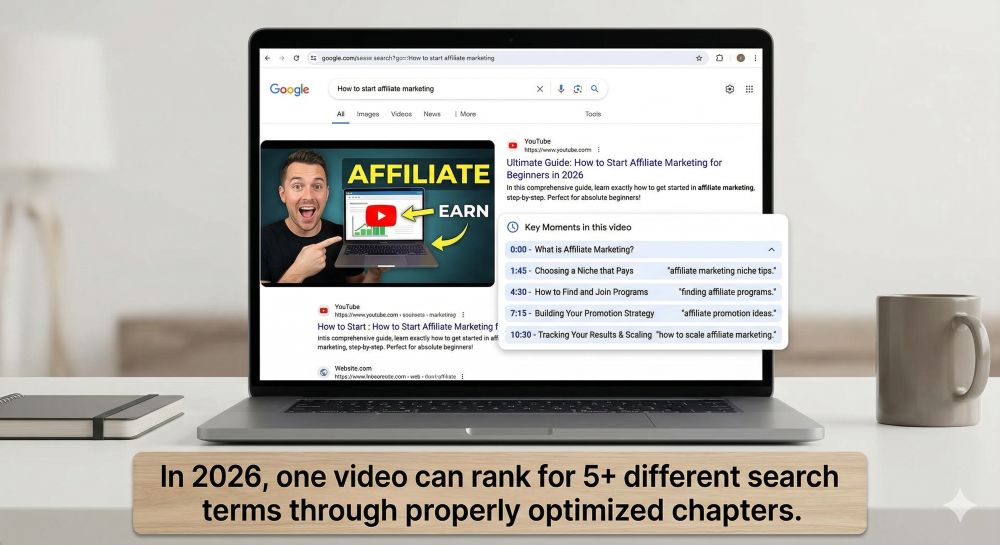
In 2026, YouTube SEO isn't just happening on YouTube. With the rise of AI-integrated search engines (like Google’s Search Generative Experience), your videos are now being indexed as "answers."
YouTube is increasingly using automatic transcription to pull specific clips from your video to answer questions directly on the Google search results page. This means that how you speak in your video and how you structure your chapters is now just as important as the text in your description box.
Phase 1: High-Intent Keyword Research
In 2026, keyword research is no longer just about finding high-volume terms; it’s about finding underserved intent. With AI now summarizing the top answers for broad queries, small to mid-sized channels must pivot toward specific, multi-word phrases where personal experience and nuance still beat generic AI overviews.
Show your audience that where their traffic comes from dictates how many people click. This emphasizes why YouTube Search is the king of conversion for business owners.
| Traffic Source | Organic CTR Benchmark (2026) | Intent Level |
| YouTube Search | 12.5% | High |
| Suggested Videos | 9.5% | Moderate |
| Browse (Home Feed) | 3.5% | Low |
The Golden Filter: Target the Long-Tail
For a channel to rank quickly, you need to look for keywords that follow the 4+ Rule: search phrases containing four or more words.
Broad (Hard): "Affiliate Marketing"
Long-Tail (Target): "Affiliate marketing for stay at home moms 2026" These specific phrases are 3x to 5x easier to rank for because they signal a very specific user pain point that larger, "broad" channels often overlook.
The "Underscore Technique" for Mining Gaps
One of the most effective ways to find what people are actually typing (without paying for expensive software) is the Underscore Technique:
- Go to the YouTube search bar.
- Type your primary topic, but place an underscore and a space before it (e.g.,
_ youtube seo). - YouTube will fill in the blank with high-volume modifiers like "best," "how to do," or "automated." This reveals the exact "intent triggers" viewers are using right now.
Zero-View Keyword Mining
This is the secret sauce for 2026. Use tools to find keywords where:
- Search Volume is rising (check Google Trends with the "YouTube Search" filter).
- Top Results are outdated: If the top three videos for a search term are more than 6-12 months old, that is a "content gap." YouTube is hungry for a fresh, updated perspective, giving you a massive "New Video" ranking boost.
The 2026 Tool Stack
To stay competitive, you need a mix of "Ground-Truth" data and AI analysis:
YouTube Autocomplete: Still the #1 source for real-time human intent.
VidIQ / TubeBuddy: Essential for seeing "Keyword Difficulty" scores directly in your browser. Target scores above 40 for the best balance of volume and competition.
OutlierKit / Ask Studio AI: These newer tools help identify "Outlier" topics—videos that performed 10x better than a channel's average—signaling a viral keyword opportunity.
Phase 2: Metadata That Actually Moves the Needle
In 2026, metadata serves a dual purpose: it acts as coordinates for the YouTube algorithm and as ad copy for the human viewer. With the rise of AI-driven search, your metadata must be structured so that both a machine and a person can understand the value of your video in less than two seconds.
The 40-Character Rule for Titles
On mobile devices—where over 70% of YouTube views happen—titles are often truncated after the first 40 to 50 characters.
The SEO Rule: Your primary "High-Intent" keyword must appear in those first 40 characters.
The Hook Rule: You must include a "Power Word" (e.g., Proven, Secret, Fast, Stop) to trigger curiosity.
The Formula:[Power Word] + [Primary Keyword] + [The Outcome/Benefit]
Example: "Proven YouTube SEO Strategy for 2026: Rank #1 Fast"
The First 125 Characters: Your Search Snippet
The top two lines of your description are what appear in search results. Don’t waste this space with "Welcome back to my channel." Instead, use it to reiterate the problem you are solving.
Natural Language: Write this for a human, but naturally weave in 2-3 "LSI" (Latent Semantic Indexing) keywords—related terms like algorithm, ranking, and video optimization.
The AI Signal: This snippet helps Google’s AI determine if your video is a "Direct Answer" for featured snippets.
The Power of Chapters & Timestamps
YouTube "Key Moments" are no longer optional for high-ranking content. By adding timestamps to your description, you are effectively creating "mini-videos" within your main upload.
Search Real Estate: Each chapter can rank individually in Google Search.
User Experience: In 2026, the algorithm rewards "Segment Satisfaction." If a user jumps to a specific chapter and watches it to the end, that counts as a positive ranking signal for the entire video.
Format:
- 0:00 Intro: The SEO Shift
- 2:15 Keyword Research Hack
- 5:30 Thumbnail Secrets
Tags: The 2026 Reality Check
While tags have become less important over the years, they still serve as "disambiguation" tools. Use them to clarify your niche (e.g., Home Business, Digital Marketing) and to catch common misspellings of your keywords. Focus on 5–8 highly specific tags rather than 50 generic ones.
Phase 3: The Retention-First Production Strategy
In 2026, the YouTube algorithm has moved almost entirely to a Satisfaction-Based Model. You can have the perfect title and a high-volume keyword, but if viewers abandon your video early, YouTube will stop showing it in search results. High rankings are now a reward for keeping people on the platform.
| Video Length | "Good" Retention | "Excellent" Retention |
| 3 - 5 Minutes | 50%+ | 65%+ |
| 5 - 10 Minutes | 45%+ | 60%+ |
| 10 - 20 Minutes | 40%+ | 55%+ |
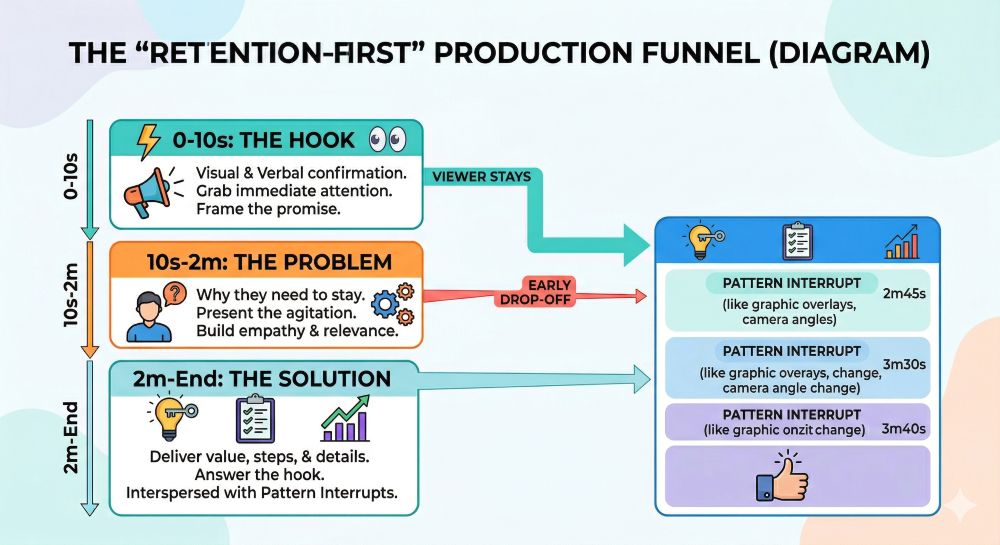
The 10-Second Hook: Eliminating the Early Drop-off
Data shows that the first 10 seconds determine the fate of your video's SEO. To rank #1, you must slash your "Early Drop-off" rate (the percentage of people who leave immediately).
The "No-Fluff" Start: Skip the long animated intros and the "Hey guys, welcome back."
The Visual Confirmation: Within three seconds, visually show the viewer exactly what they clicked for. If the title is about "SEO Tools," have those tools on the screen immediately.
The "Open Loop": Mention a specific "secret" or "bonus tip" that you will reveal at the end of the video to give them a reason to stay.
Pattern Interrupts: Fighting Viewer Boredom
Viewer fatigue is the enemy of AVD (Average View Duration). To keep the algorithm happy, you need a "Pattern Interrupt" every 45 to 90 seconds.
B-Roll & Overlays: Don't just be a "talking head." Switch to screen recordings, stock footage, or simple text pop-ups.
The Pacing Shift: Change your camera angle (even a digital zoom-in) or your background music to "reset" the viewer's attention span.
Questioning: Ask a rhetorical question to prompt the viewer to think, which re-engages their brain with your content.
The Shadow Signal: Viewer Satisfaction Surveys
YouTube now uses "Shadow Signals"—metrics you can't always see in your basic analytics—to rank content. One of the biggest is the Post-Watch Survey.
The Goal: You want viewers to feel "Satisfied" after watching.
Strategy: Ensure your video actually delivers on the promise of the thumbnail. If you "clickbait" a viewer into a video that doesn't answer their question, they will rate it poorly in surveys, and your search ranking will plummet.
Optimizing for Session Watch Time
YouTube rewards videos that keep users on the site, even after your video ends.
The "Next Video" Hook: Instead of saying "Thanks for watching, goodbye," say: "Now that you know how to find keywords, you need to know how to build the perfect thumbnail, which I cover in this video right here."
End Screen SEO: Use your end screens to link to a highly relevant video or a playlist. If a viewer watches two of your videos in a row, the algorithm views your channel as a "High Authority" source for that topic.
Phase 4: Beyond the Upload (Engagement Signals)
The work doesn’t stop once you hit "Publish." In 2026, YouTube’s algorithm looks at the initial velocity and the depth of engagement to determine if your video deserves to move from page five to page one. Engagement is no longer just about the number of likes; it's about the "meaningful interactions" that signal your content is sparking a community.
The First 48 Hours Velocity
The algorithm uses the first two days to test your video. If you can drive a surge of traffic quickly, YouTube will give you a "Search Boost" that can last for months.
The Subscriber Push: Use your community tab and email list to drive a concentrated burst of views immediately after uploading.
The "Search-to-Click" Signal: If people find your video by searching for the keyword and then click it, that is the strongest ranking signal you can send.
The Pinned Comment Hack
The comment section is an SEO goldmine. YouTube tracks how many viewers scroll down and how long they spend reading/typing.
The Conversation Starter: Don't just pin a link. Pin a thought-provoking question related to your video’s topic. For example: "Which of these three SEO tools are you using right now? Let me know below!"
Keyword Rich Replies: When you reply to comments (which you should do for at least the first hour), naturally include your keywords. It helps the algorithm further contextually "map" your video.
Shares: The Ultimate Authority Signal
External shares are a massive vote of confidence for your SEO. When a video is embedded on a high-authority blog or shared on social platforms, it tells YouTube that your content has value outside of their ecosystem.
The "Forum" Strategy: Share your video in relevant subreddits or Facebook groups—but only as a helpful answer to a specific question.
Micro-Influencer Outreach: If you mention a specific tool or brand, tag them on Instagram or LinkedIn. A single "Retweet" from a brand can skyrocket your video’s authority.
The Dislike Myth
It’s worth noting that in 2026, "Dislikes" are still engagement. While no one likes seeing them, a dislike tells the algorithm that the viewer had an emotional reaction and engaged with the content. As long as your Satisfied Watch Time remains high, a few dislikes won't hurt your ranking—in fact, they can sometimes make the engagement profile look more "natural" to the AI.
Shorts vs. Long-Form: A Decoupled Strategy
In 2026, the bridge between YouTube Shorts and long-form video has been fully integrated into the SEO ecosystem. While they serve different purposes, a "Decoupled Strategy" allows you to use the high-velocity discovery of Shorts to fuel the high-authority rankings of your long-form content.
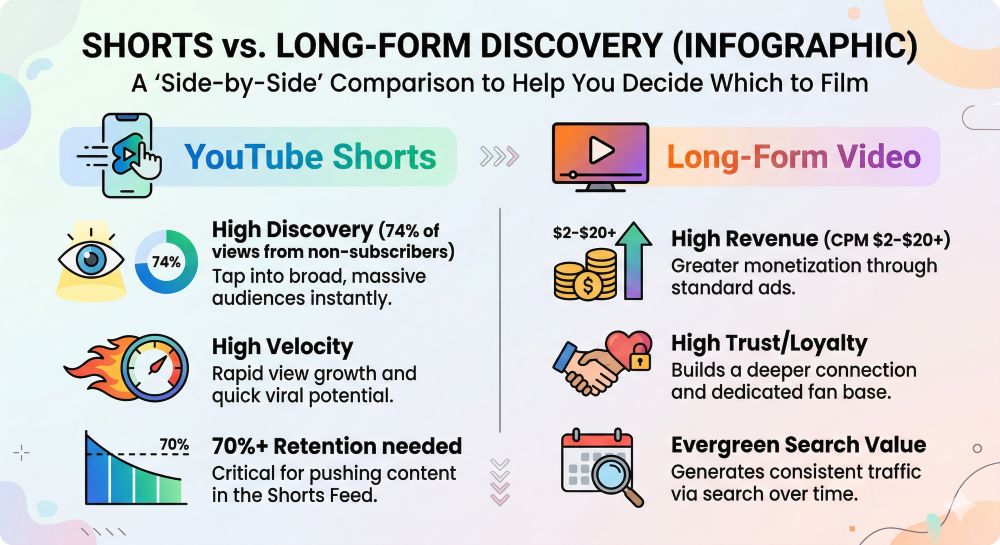
Shorts SEO: Optimization for the "Swipe"
SEO for Shorts is less about keywords and more about Categorization Signals and Retention Benchmarks.
The Swipe-Away Ratio: The most critical metric in 2026. If more than 30% of viewers swipe away before 3 seconds, the algorithm stops pushing the Short. Optimize your first 1.5 seconds with a high-contrast visual or a "Wait for it" text overlay.
Hashtag Authority: Unlike long-form, hashtags (#YouTubeSEO, #MarketingTips) are vital for Shorts. They tell the "Shorts Feed" algorithm which neighborhood of viewers to test your video in first.
Audio Trends: Using trending (but relevant) audio at a low volume (5–10%) can "piggyback" on the search volume of that specific audio track.
The "Related Video" Bridge
The most powerful SEO tool for a creator today is the Related Video link within the Shorts player.
The Funnel: Create a 50-second Short that identifies a problem (e.g., "Why your YouTube tags are useless").
The Hook: At the 45-second mark, tell them the full solution is in the linked video.
The SEO Impact: This creates "External Referral" traffic to your long-form video, which YouTube interprets as a massive signal of quality.
Shorts as a "Keyword Laboratory"
Unsure if a specific topic will rank well? Use Shorts as a testing ground.
- Post three 15-second Shorts on three different sub-topics (e.g., Thumbnails, Keywords, Lighting).
- The Short with the highest View-through rate and Shares indicates the "hottest" topic.
- Produce a high-production, 10-minute long-form video on that winning topic. You are now creating content that you already know the audience is searching for.
Maintaining Brand Search
When you dominate the Shorts feed in your niche, users start searching for your channel name directly. This "Brand Search" is one of the highest-weighted SEO signals; it tells YouTube you are a trusted authority, making it significantly easier to rank for competitive terms in the future.
Your 2026 Strategy
YouTube SEO in 2026 is no longer a static checklist of keywords; it is a dynamic relationship between your content and the viewer’s experience. As the algorithm becomes more human-like in its ability to judge quality, your success depends on your ability to provide genuine value while making it easy for AI crawlers to categorize your expertise.
The "Quality over Frequency" Reality
The old advice of "post every day" has been replaced by Topic Authority. One high-retention video that fully answers a user’s query will do more for your long-term SEO than ten mediocre uploads. Focus on becoming the "go-to" resource for your specific niche, and the search rankings will follow.
The 2026 YouTube SEO Audit Checklist
Before you hit "Publish" on your next video, run through this final sanity check:
[ ] The 40-Character Hook: Is your main keyword in the first 40 characters of the title?
[ ] The "No-Fluff" Intro: Does the video deliver on the title’s promise within the first 10 seconds?
[ ] AEO-Friendly Chapters: Have you added timestamps with descriptive, keyword-rich titles in the description?
[ ] The Engagement Prompt: Do you have a pinned comment that asks a specific, open-ended question to spark a "Conversation Signal"?
[ ] The Bridge: If you have a related Short, have you linked it to this long-form video to drive initial velocity?
[ ] Thumbnail Contrast: Does your thumbnail stand out against both "Light Mode" and "Dark Mode" users?
The creators who win in 2026 are those who treat SEO as a way to connect, not just to rank. By focusing on Viewer Satisfaction and high-intent long-tail keywords, you’re not just building a channel—you’re building a searchable library of authority that works for you 24/7.
<3 Becca